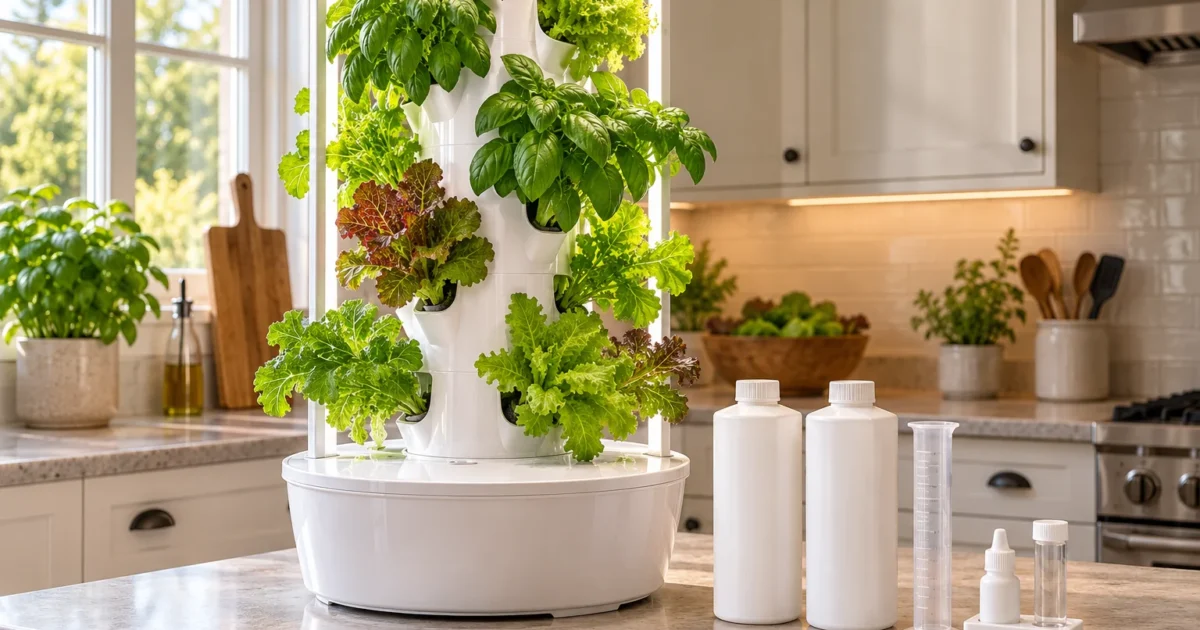
Tower Garden Mineral Blend: What’s in It, and Which Substitutes Work
A gallon pair of Tower Garden Mineral Blend was listed at $65 when we checked, and a HOME or FLEX reservoir takes it by the hundred milliliters. If you are running low, or tired of buying it, the question is whether a generic hydroponic nutrient can do the same job in your tower.
This page covers what the US blend is, what a replacement has to match, four documented substitutes with the maker’s own amounts, how to keep pH and strength in line, what a fill costs, and what Tower Garden’s warranty says. None of the substitutes is a Tower Garden-approved equivalent, and we found no controlled test comparing them with Mineral Blend in a HOME or FLEX.
The Short Answer
- Can a substitute work? The table below gives four candidates’ recipes, each with a link to its own source. Their makers’ instructions show they are hydroponic nutrients with published recipes. They do not show identical results in a tower.
- What must not be skipped: a substitute has to supply the whole nutrient list, and a base fertilizer that needs companion salts must be judged with those salts included.
- What it costs: by our arithmetic, a full HOME fill runs from $1.09 to $4.46 and a FLEX fill from $1.68 to $6.87 across the five products below, on October 17, 2026 listings.
- Warranty: the reviewed warranty does not name third-party nutrients. It voids coverage for “self-made modifications or improper use.” We cannot tell you how Tower Garden would read a substitute.
Tower Garden Mineral Blend: What the Bottles Are
The US product is a two-part liquid concentrate sold as separate A and B bottles. Tower Garden’s directions call for 20 mL of A plus 20 mL of B per gallon of water. For small seedlings the directions give 10 mL of each per gallon, moving to full strength after about three weeks. In hot weather they allow half strength, or full-strength nutrients on alternate refills (Tower Garden: Mineral Blend).
Tower Garden states 13 gallons for the HOME and 20 gallons for the FLEX (HOME, FLEX). Those figures give the following, by our arithmetic.
| Reservoir | Full strength, each of A and B | Seedling rate, each of A and B |
|---|---|---|
| HOME, 13 gallons | 260 mL | 130 mL |
| FLEX, 20 gallons | 400 mL | 200 mL |
Top-ups follow the water you add, not the reservoir’s capacity. Four gallons of replacement water in a FLEX calls for 80 mL of each part at the ordinary rate, subject to the heat exceptions. Re-dosing the full 20-gallon charge after a small top-up would misread the instructions (Tower Garden: maintenance).
What is in the bottles
According to the US product page, the concentrates carry the analysis below. These percentages describe the bottles, not the diluted reservoir (Tower Garden: Mineral Blend).
| Part | Published analysis | Listed ingredient sources |
|---|---|---|
| A | Nitrogen 2.0%; calcium 1.0%; chelated iron 0.05% | Calcium nitrate; iron sodium EDTA |
| B | Phosphate (P₂O₅) 1.0%; potash (K₂O) 3.0%; magnesium 0.5%; sulfur 3.0%; boron 0.01%; copper 0.001%; manganese 0.01%; molybdenum 0.0005%; zinc 0.005% | Potassium nitrate; potassium sulfate; magnesium sulfate; boric acid; copper sulfate; manganese sulfate; sodium molybdate; zinc sulfate |
The page omits B’s nitrogen percentage and does not name a phosphorus-bearing ingredient in its text list. An older safety data sheet for B lists phosphoric acid (historical B SDS). That is a plausible explanation, but it does not prove today’s recipe, so we do not treat it as the current formula.
Tower Garden calls the blend nonorganic, explaining that it supplies mineral nutrition and uses manufactured EDTA (Tower Garden: is Mineral Blend organic?).
Check your region’s bottles
Everything above is the US product. The UK listing describes one-liter bottles as A 8-0-0 and B 0-6-12, dosed at 20 mL of each per 10 liters (Tower Garden UK: Mineral Blend A+B). Applying the US rate by volume to the UK product would deliver about 2.64 times the UK-stated concentrate per unit of water, by the research’s calculation. Follow the directions on the bottles you actually hold.
What a Substitute Must Match
Completeness. Penn State lists nitrogen, phosphorus, potassium, calcium, magnesium and sulfur, plus essential trace elements, as what a hydroponic solution must supply (Penn State Extension: essential nutrients). Matching an NPK number does not prove a product is complete.
Separation. Calcium can react with phosphate and sulfate in concentrated solutions, which is why this kind of nutrient comes in separate parts. Missouri Extension describes that chemistry (University of Missouri Extension: nutrient solutions), and Masterblend tells growers not to put calcium nitrate in a concentrated stock with its base and Epsom salt (Masterblend: concentrate FAQ). The restriction concerns mixing concentrates, not commercially formulated one-part dry products.
Strength. Electrical conductivity (EC) measures overall conductivity, not the balance of individual nutrients, so a solution can match another’s EC with different proportions of nitrogen or calcium (University of Missouri Extension). EC is useful for monitoring. It cannot prove a substitute equals Mineral Blend.
We did not find a numeric EC, TDS or ppm target for Mineral Blend in the reviewed US materials; Tower Garden’s published reference is the concentrate-to-water ratio. Do not relabel your own meter reading as Tower Garden’s target.
Crop. Oklahoma State lists lettuce at 1.2 to 1.8 mS/cm, tomatoes at 2.0 to 4.0 and peppers at 0.8 to 1.8 (Oklahoma State Extension: EC and pH guide). Those ranges overlap, so “fruiting crops always need stronger nutrients than greens” is not a rule. They are general crop ranges, not tower prescriptions.
Your water. Calcium-rich source water can change which General Hydroponics micro variant makes sense, and household ion-exchange softened water can add excess salts (General Hydroponics: FloraMicro, University of Minnesota Extension: small-scale hydroponics). Ask about your water before blaming a nutrient brand.
The Four Substitutes, With Measured Amounts
These are the makers’ selected recipes per US gallon. Treat them as documented starting points that need monitoring, not as Tower Garden-endorsed replacements. Each maker’s instructions establish its own product and program, not performance in a HOME or FLEX.
| Substitute | Amount per US gallon | What it needs | Maker’s strength or application note |
|---|---|---|---|
| Masterblend 4-18-38 | 2.4 g base + 1.5 g magnesium sulfate + 2.4 g calcium nitrate | Dissolve base, then magnesium sulfate, then calcium nitrate last | Maker says half rates until seedlings are established (Masterblend mixing table) |
| GH FloraSeries, Light Feed/Late Growth | 6.0 mL Micro + 5.6 mL Gro + 4.2 mL Bloom | All three bottles, never mixed undiluted; FloraMicro goes into fresh water first (GH: FloraMicro) | EC 1.4 to 1.7 mS/cm for that row (GH Weekly Basic chart) |
| GH MaxiGro, Outdoor 1-Part Basic, Light Feed/Late Growth | 4.6 g | Nothing extra in that program; dissolve fully | EC 1.3 to 1.6 mS/cm for that row (GH MaxiSeries Basic chart) |
| CANNA Aqua Vega A/B | Up to 0.27 fl oz of each | Matching A and B, added separately | Growth-phase product; see below (CANNA US: Aqua Vega) |
Decided? These are the substitutes this page discusses, as Amazon searches. Match the recipe to your reservoir first:
As an Amazon Associate, plantsbythebook earns from qualifying purchases. Links below are affiliate links — they cost you nothing extra.
Masterblend
The base alone is not the recipe: the maker’s row needs the magnesium sulfate and calcium nitrate as well. Published recipes also differ. One retailer lists 12, 6 and 12 g per five gallons, which works out to 2.4, 1.2 and 2.4 g per gallon, so its Epsom amount is lower than the maker’s 1.5 g (retailer kit page). We use the maker’s row and do not blend the two. Masterblend also sells an 8-15-36 Lettuce Formula, but we found no measured amounts for it, so do not carry the 4-18-38 recipe over to it (Masterblend: Lettuce Formula).
On evidence: a University of Hawaiʻi trial reported favorable lettuce results in small static hydroponic systems, including higher butterhead yield than a comparison fertilizer. Its preparation rates and static setup do not validate the recipe in the table (University of Hawaiʻi trial).
General Hydroponics Flora Series and MaxiGro
According to one grower’s account of FloraSeries in a Tower Garden, they used 4 mL per gallon of each bottle with an initial EC of 1.4 mS/cm and checked daily (grower report). That documents one use with one water supply. The maker’s chart separately gives 1.8 mL of each per gallon for seedlings and clones on light feeding (GH Weekly Basic chart).
Before buying FloraMicro, identify the variant. The standard quart trio is model HGC718978, and General Hydroponics also sells a Hardwater Micro (Hawthorne: FloraSeries quart trial pack). General Hydroponics’ product page recommends Hardwater when source water is above 200 ppm or contains more than 70 ppm calcium (GH: FloraMicro). A TDS reading does not identify calcium, so check a water analysis for the calcium figure.
MaxiGro is a standalone 10-5-14 vegetative product (GH: MaxiGro). The Outdoor 1-Part Basic chart lists MaxiGro alone for growth, with no supplement row (GH MaxiSeries Basic chart). “Standalone” does not guarantee that every water source needs nothing more.
CANNA Aqua Vega
The US page gives pH 5.2 to 6.2 and a nutrient-only EC of 0.9 to 1.4 mS/cm, assuming zero-EC source water. Detailed directions say to add A, stir, add B, stir, and wait several hours (CANNA US: Aqua Vega, CANNA: mixing directions). The Canadian page differs: 8 mL per gallon and EC 0.8 to 1.2 mS/cm (CANNA Canada: Aqua Vega). Keep the regional instructions with the bottles you bought. Aqua Vega is for the growth phase; CANNA directs growers to Aqua Flores for flowering. We found no measured HOME or FLEX outcome for it.
What the tower evidence shows
The strongest branded-hardware evidence is a strawberry experiment on FLEX towers using a modified Yamazaki solution. Its nine-layer, 36-site towers differed from the standard household configuration (Frontiers in Plant Science: FLEX strawberry study). It shows a tower can run on a non-Tower Garden solution, not that any commercial recipe above matches Mineral Blend.
Switching: pH, Strength and Testing
Mix order. For a manual batch, add the complete recipe to the water first, with components added separately and mixed thoroughly. Then adjust pH in small steps: General Hydroponics says to mix nutrients into fresh water completely before adjusting pH, add adjusting liquids sparingly, stir and re-test (GH: pH Control Kit). Professional systems may treat water with acid before fertilizer injection (Penn State Extension: pH and water quality). Opinions vary with the system and preparation method, and the homeowner sequence above is the one to follow.
Which pH range. Tower Garden’s own documents disagree. HOME setup instructions give 5.5 to 6.5 (Tower Garden: HOME setup), the older Growing System guide gives 5.0 to 7.0 (Growing System guide), and a Canadian pH Raise page gives 5.5 to 7.0 (Tower Garden Canada: pH Raise). Name the document you follow rather than assuming one range for every model.
Test kits. Tower Garden’s liquid-indicator kit was listed at $18, and its pH Raise and Lower kits at $33 each (Test kit, Raise, Lower). A distributor’s maintenance page describes five drops in a 5 mL sample; follow the instructions in whichever kit you buy (Keep It Watered).
Tower Garden’s UK FAQ discourages broad-range pH paper, while Minnesota Extension lists strips and paper among usable small-system methods (Tower Garden UK FAQ, University of Minnesota Extension). Neither supports saying all paper tests fail. Choose a test with suitable range and resolution.
Meters. Bluelab specifies ±0.1 pH at 25°C for its pH pen. It directs calibration with fresh pH 7 and 4 buffers at least monthly, and again after cleaning or odd readings. The probe needs its KCl storage solution, and RO, distilled or deionized water are not suitable for storage (Bluelab: pH Pen, calibration, probe care). Those details are for that model. If you read ppm, note the scale: Bluelab explains 500 and 700 scales derived from conductivity, so report EC or the scale used (Bluelab: conductivity scales).
How often. Tower Garden’s routine advice is weekly pH testing and testing after refilling (Tower Garden: maintenance). We found no Tower-specific switching schedule. Oklahoma State recommends closer monitoring (Oklahoma State Extension), so measuring source water and the finished batch, then checking after additions, is a reasonable approach. Daily measuring does not mean daily correction: CANNA accepts movement within its AQUA range and discourages chasing a single pH number (CANNA: AQUA pH management).
On replacement timing, Tower Garden’s older guide says to replace the solution between fresh plantings (Growing System guide). We found no universal monthly interval for a tower.
Cost per Reservoir
Prices are listings we recorded on October 17, 2026, before tax, water, shipping, meters and pH products. Four of the five are retailer or marketplace listings, so they show that seller’s price, not a shelf price. Each kit is charged across the gallons possible before its first component runs out, which is a purchase-budget method that leaves unused ingredients. The recipes do not supply equivalent elemental nutrition.
| Product and listed price | Gallons per package | HOME fill (13 gal) | FLEX fill (20 gal) |
|---|---|---|---|
| Mineral Blend, gallon each A/B, $65 (Tower Garden) | 189.27 | $4.46 | $6.87 |
| Masterblend kit, 1 lb base, 0.5 lb Epsom, 1 lb calcium nitrate, $27.95 (retailer) | 151.20 | $2.40 | $3.70 |
| FloraSeries quart trio, $36.95 (retailer) | 157.67 | $3.05 | $4.69 |
| MaxiGro 2.2 lb, $18.25 (retailer) | 216.9 | $1.09 | $1.68 |
| Aqua Vega, liter each A/B, $34.95 (marketplace retailer) | about 125 | $3.63 | $5.58 |
Sources: Tower Garden, Masterblend kit, PA Hydroponics, Garden Supply Guys, Walmart marketplace. The fill costs use the recipes above and General Hydroponics’ 1-quart bottles, a size its Flora Series chart lists (GH Flora Series Basic chart); a US quart is about 946 mL.
Prices move. The same retailer lists a 12.5 lb Masterblend kit (5 lb base, 5 lb calcium nitrate, 2.5 lb Epsom salt) at $22.00 over its $27.95 price (retailer kit page). By our arithmetic, that comes to $0.86 for HOME and $1.32 for FLEX. Hydrobuilder listed the FloraSeries quart trial pack at a $34.38 sale price, which by the same method is about $2.83 for HOME and $4.36 for FLEX (Hydrobuilder). Aqua Vega components were listed as low as $8.95 each (component listings). A third-party FloraSeries offer on Lowe’s was $61.89, so it is not a typical price (Lowe’s marketplace).
These are fill costs. Do not turn them into an annual saving: replacement schedules differ, as above, and a continuous crop changes the picture.
What Tower Garden Says About Other Nutrients
Tower Garden’s current US warranty says “any self-made modifications or improper use to the product will void the warranty.” It also excludes consumables, including Mineral Blend and pH kits (Tower Garden: warranty). That wording does not name third-party nutrients, and it is not approval of any replacement formulation.
We did not find, in the materials reviewed, an explicit “use only Tower Garden nutrients” requirement, an automatic warranty cancellation for another brand, or a pump-damage warning about generic nutrients. That is a bounded search result. It does not guarantee coverage. We also found no manufacturer endorsement or troubleshooting commitment for Masterblend, FloraSeries, MaxiGro or Aqua Vega. If warranty certainty matters, ask Tower Garden about your model before switching. This is a reading of the documents, not legal advice.
What to Do Next
Pick the substitute whose water and companion-salt requirements you can actually meet, mix it from the maker’s own row, and test pH and strength after the first additions. Keep the recipe and the date you changed it in a note, so a problem can be traced. For related guides, visit the Smart & Indoor Gardens hub.
Can I use Masterblend instead of Tower Garden Mineral Blend?
It is a documented candidate, not an endorsed replacement. The maker’s one-gallon recipe is 2.4 g base, 1.5 g magnesium sulfate and 2.4 g calcium nitrate, and the base alone is incomplete (Masterblend mixing table).
How much Mineral Blend does a full reservoir take?
Tower Garden’s US full-strength rate is 20 mL each of A and B per gallon of water (Tower Garden: maintenance). By our arithmetic, that is 260 mL of each for a 13-gallon HOME and 400 mL of each for a 20-gallon FLEX. Seedlings take half that.
Will using another nutrient void my Tower Garden warranty?
The reviewed warranty names “self-made modifications or improper use” and excludes consumables, but does not mention third-party nutrients (Tower Garden: warranty). We found no automatic cancellation clause. We also cannot promise coverage.
Is Mineral Blend organic?
Tower Garden calls it nonorganic, citing its mineral nutrition and manufactured EDTA (Tower Garden: is Mineral Blend organic?).
If my EC matches, is my substitute equivalent?
No. EC measures overall conductivity, not the balance of nitrogen, calcium and other elements (University of Missouri Extension).
Sources
- Tower Garden: Mineral Blend
- Tower Garden: HOME
- Tower Garden: FLEX
- Tower Garden: maintenance
- Tower Garden: is Mineral Blend organic?
- Tower Garden: warranty
- Tower Garden: test kit
- Tower Garden: pH Raise kit
- Tower Garden: pH Lower kit
- Tower Garden UK: Mineral Blend A+B
- Tower Garden UK: FAQ
- Tower Garden: HOME setup
- Tower Garden Canada: pH Raise
- Tower Garden Growing System guide (historical, third-party host)
- Tower Garden Mineral Blend B safety data sheet (historical, third-party host)
- Masterblend: 4-18-38 mixing instructions
- Masterblend: concentrate FAQ
- Masterblend: 8-15-36 Lettuce Formula
- General Hydroponics: FloraSeries Weekly Basic feed chart
- General Hydroponics: FloraMicro
- General Hydroponics: MaxiGro
- General Hydroponics: MaxiSeries Basic feed charts
- General Hydroponics: pH Control Kit
- CANNA US: Aqua Vega
- CANNA Canada: Aqua Vega
- CANNA: Aqua Vega mixing directions
- CANNA: AQUA pH management
- Bluelab: pH Pen
- Bluelab: calibrate the pH Pen
- Bluelab: pH probe care
- Bluelab: conductivity scales
- Penn State Extension: essential nutrients
- Penn State Extension: pH and water quality
- University of Missouri Extension: nutrient solutions
- University of Minnesota Extension: small-scale hydroponics
- Oklahoma State Extension: EC and pH guide
- University of Hawaiʻi lettuce trial
- Frontiers in Plant Science: FLEX strawberry study
- Rooting DC: FloraSeries in a Tower Garden
- Hawthorne: FloraSeries quart trial pack
- Keep It Watered: weekly maintenance
- All Natural Jams: Masterblend kit
- PA Hydroponics: FloraSeries quarts
- Hydrobuilder: FloraSeries quart trial pack
- Lowe’s: FloraSeries
- Garden Supply Guys: MaxiGro
- Walmart marketplace: Aqua Vega pair
- CreatorHydro: CANNA Aqua component listings
Educational content only. Not a substitute for licensed professional or extension-office advice. Local climate, frost timing, and site conditions vary by yard and region. Use of any guidance from this guide is at your own risk.
What fits your system
As an Amazon Associate, plantsbythebook earns from qualifying purchases. Links below are affiliate links — they cost you nothing extra.
- Masterblend 4-18-38 hydroponic fertilizer kit (search by name) — A base fertilizer that is only complete with magnesium sulfate and calcium nitrate added, per the maker's mixing table. Not endorsed by Tower Garden.
- General Hydroponics Flora Series quart trio, HGC718978 (search by name) — Three bottles (Micro, Gro, Bloom) used together from the maker's feed chart. Check whether your water calls for the Hardwater Micro variant.
- General Hydroponics MaxiGro 10-5-14 (search by name) — A dry one-part vegetative nutrient. Its selected outdoor program lists no extra supplement, but your water may still need management.
More in this guide
- AeroGarden Replacement Light: Which Bulb or LED Hood Fits Your Model? Your garden’s light has gone dark, flickers, or cracked, and you want an AeroGarden replacement light that fits. The catch is that…
- Gardyn HydroBoost: What It Does, Whether You Need It, and What to Use Instead You own a Gardyn, and every time you order plant food, Gardyn HydroBoost sits next to it at $49.99 a bottle. It…
- Which Replacement Pump Fits Your Indoor Garden? Matching the Pump to Your Model Number The water has stopped circulating, the pump hums or does nothing, and the replacement you found online says “fits most gardens.” Working…
- Is AeroGarden Discontinued? What Actually Happened, and What Still Fits If you typed is AeroGarden discontinued into a search bar because your reminder light is blinking and you cannot find replacement pods,…
- Smart Garden Pod Types: Round, Square, and Soil-Wick Explained Shop for refill pods for a countertop hydroponic garden and you’ll find dozens of listings claiming to fit “most systems” – which…
- Smart Garden Proprietary Pods: Which Brands Lock You In (And Which Don’t) The sticker price on a countertop hydroponic garden is not the real cost – the pods, nutrients, and subscriptions you buy for…
- Can You Use General Hydroponic Nutrients in a Smart Garden? Whether you can use general hydroponic nutrients in a smart garden comes down to one test: does your system feed plants from…
- Which Pods Fit My AeroGarden? Compatible Pods + Nutrients Guide If your AeroGarden pods are getting harder to find – or you have hit the unit’s “buy more pods” wall and balked…
Related guides
AeroGarden Replacement Light: Which Bulb or LED Hood Fits Your Model?
Your garden’s light has gone dark, flickers, or cracked, and you want an AeroGarden replacement light that fits.…
Gardyn HydroBoost: What It Does, Whether You Need It, and What to Use Instead
You own a Gardyn, and every time you order plant food, Gardyn HydroBoost sits next to it at…
Which Replacement Pump Fits Your Indoor Garden? Matching the Pump to Your Model Number
The water has stopped circulating, the pump hums or does nothing, and the replacement you found online says…