Plants for a Dry Sunny Slope: What Actually Survives There
A hot, dry, south-facing slope is not solved by a generic “drought tolerant plants” list. It is a site-selection problem with several layers stacked on top of each other — winter cold, sun exposure, slope grade, drainage, and how the plant’s roots handle both baking heat and the occasional downpour that wants to wash it downhill. Finding good plants for a dry sunny slope means working through those layers in order, not grabbing the first plant tagged “xeriscape” at the garden center.
This guide walks through that sequence: how to gate candidates by your USDA hardiness zone, why the slope’s exposure and grade matter as much as the plant list, how to get new plants through their first dry season without wasting water, and which specific plants hold up once they’re established — along with the regional caveats that change the answer depending on where you garden.
Plants for a Dry Sunny Slope: Start With Your USDA Zone
Before you look at a single plant, find your USDA Plant Hardiness Zone. The map is built from the average annual extreme minimum winter temperature, using 30 years of data jointly developed by USDA ARS and Oregon State University’s PRISM Climate Group (USDA ARS 2023 PHZM release). That number tells you whether a perennial can survive your winter — nothing else. It says nothing about how hot your summers run, how much rain you get, or how fast water drains off a slope. University of Maine Extension is direct about this: the zone map leaves out summer heat, wind, drainage, soil fertility, and ongoing management, all of which matter more than winter cold on a dry, sunny slope (University of Maine Extension). If you haven’t looked yours up yet, USDA Plant Hardiness Zone: Find Yours & What It Means covers how, and why zone 5 and zone 9 dry slopes should never get the same plant list.
Treat your zone as a first filter, not a final answer. It narrows the field to plants that can survive your winter; everything else on this page narrows it further.
Why Slope Exposure and Grade Change the Answer
In much of the Northern Hemisphere, south- and west-facing slopes take the hardest hit. Utah State University Extension explains why: south-facing ground receives more direct solar radiation, its snow melts earlier, and it runs drier and less humid than a north- or east-facing slope at the same elevation (USU Extension). That’s the exposure most homeowners mean when they describe a “hot, dry slope” — full sun, fast-draining soil, and little shade relief for most of the day. For a fuller walkthrough of how sun exposure works across a whole yard, not just a slope, see Full Sun, Part Shade, or Full Shade: Read Your Yard.
Grade matters just as much as exposure, and Iowa State University Extension gives concrete thresholds worth knowing before you plant. A slope under about 5% has few special planting issues. Between roughly 8% and 16%, the slope needs deliberate planting strategies rather than a flat-ground approach. Around 20% or steeper counts as a genuinely steep slope, about 30% is generally too steep to mow, and around 50% is often the steepest grade that can still support plant growth at all (Iowa State Extension). If your slope is at the upper end of that range, NC State’s New Hanover Extension notes that very steep or unstable ground may need regrading or a retaining structure before planting solves anything — plants alone are not always the fix (NC State New Hanover Extension).
Root architecture matters on any slope you do plant. Both the University of Arizona Cooperative Extension and Colorado State University Extension point to low, dense, spreading plants with fibrous or extensive root systems as the strongest choice for holding soil in place (University of Arizona Cooperative Extension). Iowa State adds a layering point worth building into your design: plantings at different heights scatter raindrops before they hit bare soil, which controls erosion better than a single flat groundcover layer.
Manage the Water Before You Plant
The most common design mistake on a dry slope isn’t the plant choice — it’s letting water run downhill unmanaged. Iowa State recommends dealing with upslope runoff first: redirect or slow water coming from downspouts, driveways, and other hard surfaces before it ever reaches your planting area, and stagger plantings so water doesn’t collect and channel down straight rows. Where rows are unavoidable, orient them perpendicular to the slope or along contour lines rather than running straight downhill (Iowa State Extension). NC State’s New Hanover Extension gives the same advice from the erosion-control side: slow stormwater before it reaches the slope, rather than trying to stop it once it’s already moving.
Clearing existing grass and weeds before planting is not a universal rule on a slope the way it is on flat ground. Extension guidance genuinely differs here: some programs recommend removing turf and weeds before establishing new plantings, while Iowa State’s slope-specific guidance says that on erosion-prone ground, killing existing turf with a short-residual herbicide and leaving the dead roots and top growth in place can help hold soil while new plants establish. Both approaches can be correct depending on how much erosion risk the site already carries — treat “clear everything first” as a flat-ground default, not a slope rule, and lean toward minimal soil disturbance if your slope is already eroding.
Temporary erosion control has a similar site-dependent answer. Mississippi State Extension allows hay, open plastic netting, or erosion fabric to stabilize loose soil until plants take hold, and Iowa State and NC State separately support biodegradable jute or coir erosion blankets for the same purpose. Colorado State University Extension warns against a different product, though: permanent synthetic weed-barrier fabric under mulch, which can block water and air exchange without actually stopping weeds long-term (Colorado State University Extension). Temporary, biodegradable fabric during establishment is the safer call; permanent weed fabric is not.
One more prep detail Iowa State flags: a slope can bury a tree’s trunk flare or a perennial’s crown more easily than flat ground does, simply from soil settling and slope grading. Keep the crown at grade, and don’t pile mulch against it — the UC ANR San Luis Obispo Master Gardeners and Colorado State University Extension both warn that damp soil or mulch against a crown or trunk contributes to rot (CSU Extension, mulching).
Plants That Actually Fit a Dry, Sunny Slope
Once your zone, exposure, and drainage are sorted, these are the strongest supported candidates — each with the caveat that makes it work or fail on your specific slope.
| Plant | Botanical name | Zones | Site fit | Key caveat |
|---|---|---|---|---|
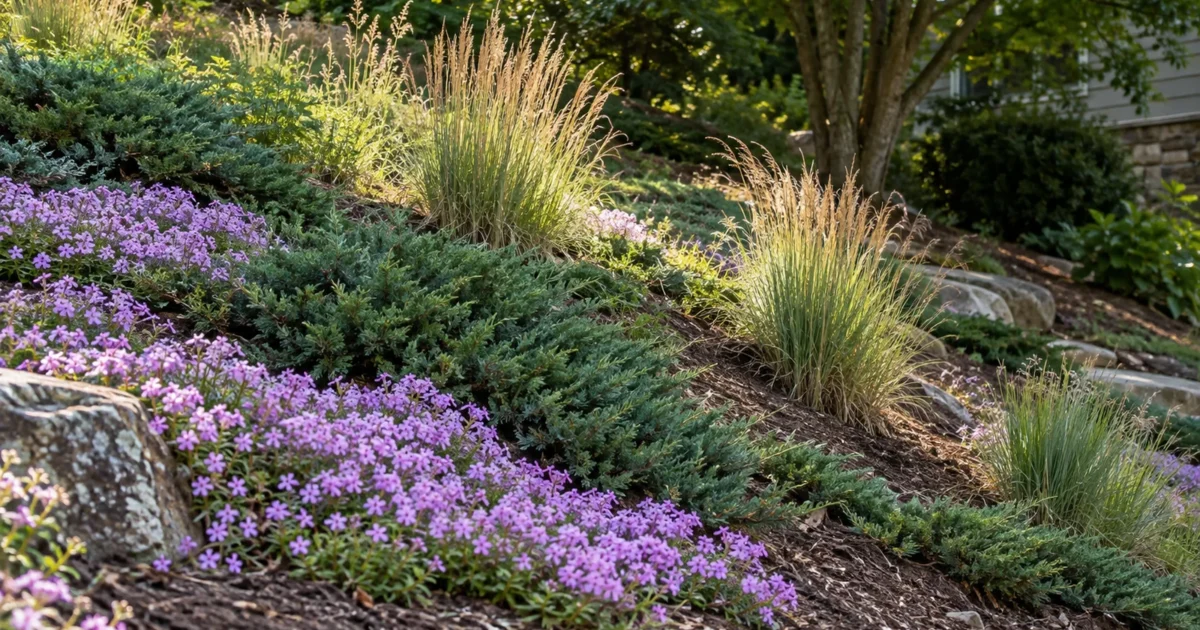
| Moss phlox (“creeping phlox”) | Phlox subulata | 3a-9b | Full sun, dry, rocky or sandy, well-drained | “Creeping phlox” is ambiguous — see naming note below |
| Creeping juniper | Juniperus horizontalis | 3a-9b | Full sun, sandy or shallow rocky soil, good drainage | Disease risk in shade or poor drainage; cultivars vary widely |
| Little bluestem | Schizachyrium scoparium | Wide range | Full sun, dry to medium, well-drained | Excellent drought resistance once established |
| Blue grama | Bouteloua gracilis | Wide range | Full sun, poor, dry, well-drained soil | Avoid dense shade, flooding, high water table, acid soil |
| Russian sage | Salvia yangii | Wide range | Full sun, well-drained, occasionally dry | Avoid wet or poorly drained soils |
| Rosemary | Salvia rosmarinus | Warmer zones | Full sun, dry to medium, well-drained | Low tolerance for wet, humid conditions |
| Yarrow | Achillea millefolium | Wide range | Full sun, dry, well-drained | Can spread aggressively; toxic to pets (see below) |
Sources: NC State Plant Toolbox (Phlox subulata, creeping juniper, little bluestem, Russian sage, rosemary, yarrow), USDA Forest Service FEIS (blue grama), USA National Phenology Network (blue grama).
Get the name right before you buy moss phlox. “Creeping phlox” is used loosely for two different plants: Penn State applies the name to Phlox stolonifera, while NC State lists it among the common names for Phlox subulata (NC State Extension, Phlox subulata). For a hot, dry, rocky slope, Phlox subulata is the stronger fit — NC State describes it as suited to dry, rocky, or sandy slopes and more tolerant of hot, dry conditions. Phlox stolonifera, by contrast, prefers moist, well-drained, slightly acidic soil and tolerates more shade and moisture than P. subulata does (NC State Extension, Phlox stolonifera). Shop by botanical name, not the common name alone, or you may plant the wrong phlox for a dry slope.
Creeping juniper needs the same cultivar-level caution. NC State supports Juniperus horizontalis broadly for full sun, sandy or shallow rocky soils, good drainage, and occasionally dry conditions, but Virginia Tech Extension notes that shade and poor drainage predispose it to disease, and that cultivars vary widely in form, height, spread, and berry production (Virginia Tech Extension). The cultivar ‘Wiltonii’ (often sold as “blue rug juniper”) is specifically called out by NC State as a good fit for dry, sunny, sloped conditions — treat that as a cultivar-specific recommendation, not proof every creeping juniper cultivar behaves the same way.
Blue grama and little bluestem are both strong native-grass options for a dry slope, and both do real erosion-control work through their root systems. Blue grama tolerates poor, dry soil and drought, but the USDA Forest Service’s Fire Effects Information System notes that prolonged drought can still reduce its roots and production, and it doesn’t suit dense shade, flooding, high water tables, or acid soils (USDA Forest Service FEIS). Little bluestem is supported for full sun and dry-to-medium, well-drained soil with excellent drought resistance once it’s established — the recurring theme on this whole list.
Russian sage and rosemary both fit dry, sunny, well-drained sites, but both fail the same way in the wrong climate: too much moisture. NC State supports Russian sage for full sun and well-drained, occasionally dry soil while specifically warning it away from wet soils, and supports rosemary for the same dry, sunny conditions while noting its low tolerance for wet, humid environments. If you garden in a humid region, both plants need drainage even more than they need sun — see the regional section below.
Yarrow needs its own caveat before it goes on any slope. It’s a legitimate drought-tolerant, erosion-holding plant, but NC State notes it can spread aggressively by rhizomes and seed, and UC IPM calls common yarrow weedy in maintained landscapes (NC State Extension, yarrow). The honest description is “can spread aggressively or behave weedily in a maintained landscape,” not “invasive everywhere” — the USDA Forest Service’s own species review classifies it as noninvasive at that level.
Yarrow is also listed by the ASPCA as toxic to dogs, cats, and horses, so keep it out of reach if pets use the slope. Moss phlox and rosemary, by contrast, are both listed as non-toxic to dogs, cats, and horses (ASPCA yarrow, ASPCA moss phlox, ASPCA rosemary).
Getting Plants Established Without Wasting Water
“Drought tolerant” is a claim about a mature, established plant — not a new one straight out of a nursery pot. Colorado State University Extension is direct that native and drought-tolerant species are not actually drought tolerant until their root systems are established, and Clemson, the University of Nebraska-Lincoln, and the UC Davis Arboretum all confirm the same point: every one of these plants still needs regular water while it settles in (Colorado State University Extension).
CSU gives a specific establishment schedule worth following: water daily for the first two weeks after planting, every two to three days for the next two months, then weekly through about week 12, until the roots are established. Check the original root ball specifically during that period — Iowa State notes it can dry out faster than the surrounding soil — and check the soil profile itself rather than judging moisture from the surface alone, which Washington State University Extension also recommends (WSU Extension).
Readers in California’s dry-summer climate have a more specific timing window. UC ANR recommends planting from November through February so roots establish before summer heat arrives, with weekly watering through the first year before tapering to occasional or no irrigation, depending on the plant and site (UC ANR dry-garden tips). That first-year schedule is establishment guidance, though — once these plants are established, treat it as separate from ongoing care in a dry-summer climate, covered next.
Mistakes That Kill Plants on a Dry Slope
The single biggest mistake is planting a drought-tolerant species and then walking away from it immediately. Every plant on the list above needs consistent water through its first season or two — skip that, and “drought tolerant” won’t save it.
A close second is using your USDA hardiness zone as a stand-in for a heat, drought, or drainage rating. It measures winter cold only. A zone-appropriate plant can still fail on a slope if the exposure, drainage, or grade is wrong for it.
Planting a single species across the whole slope is a real risk, not just a design preference. Penn State Extension warns that a pest or disease outbreak can wipe out a monoculture planting in one pass, and layering different plants at different heights — as Iowa State recommends for erosion control — also builds in some resilience against that.
Reaching for an aggressive vining groundcover as default erosion control is a mistake in most regions. NC State’s New Hanover Extension specifically warns against vinca, Asiatic jasmine, and English ivy for erosion work, noting they can grow unchecked and invade natural areas; some older regional guidance still lists these plants, so check your own state’s invasive-plant list before you plant any aggressive vine on a slope.
Piling soil or mulch against a crown or trunk flare is an easy mistake to make while grading a slope for planting. Keep the crown visible at grade and keep mulch pulled back from it, per the CSU and UC ANR guidance cited above — buried crowns and mulch-smothered trunks are a common cause of unexplained plant failure on newly graded slopes.
And don’t assume a low groundcover means low maintenance. Colorado State University Extension is clear that all groundcover plantings require upkeep, and Virginia Tech notes that low-growing junipers specifically can let weed seed germinate underneath because of their short height — persistent weeds in a juniper bed are often a sign the planting needs thinning, not that something’s wrong with the plant.
One more caution belongs here even though it isn’t about plant selection: never assume a plant is pet-safe just because it isn’t on the ASPCA’s toxic list. The database is explicitly not all-inclusive, so absence means unverified, not safe. Pet Safe Plants: What the ASPCA Actually Lists walks through how to check before anything goes somewhere a dog, cat, or horse can reach it.
Regional Notes for a Dry, Sunny Slope
A dry slope in the humid Southeast is a different challenge than the same slope in the desert Southwest, even with an identical grade and identical sun exposure.
In the humid Southeast, drainage is the swing factor. Rosemary has low tolerance for wet, humid conditions, Russian sage should avoid wet or poorly drained soils, and creeping juniper carries disease risk in shade or poor drainage — all three plants need real drainage engineering (not just a “well-drained soil” plant tag) to survive a humid summer (NC State Extension, rosemary).
In California’s dry-summer climate, timing flips the usual advice. UC ANR guidance from Sonoma and San Luis Obispo county programs confirms that many California natives establish best with fall planting and excellent drainage, and can actually suffer from excess summer irrigation once they’re established — the opposite problem from most of the country, where summer is when plants need the most help (UC ANR Sonoma).
In the desert Southwest, University of Arizona Cooperative Extension recommends leaning toward native or regionally adapted plants rather than a generic “drought tolerant” list pulled from a different climate — a non-native, non-desert-adapted planting can waste water and still struggle (University of Arizona Cooperative Extension, Sierra Vista).
If your slope sits near a home in a wildfire-prone region, dense erosion-control planting and defensible-space guidance can pull in different directions. CAL FIRE recommends increasing shrub spacing as slope steepness increases, with moderate-to-steep slopes over 40% needing much wider spacing near structures (CAL FIRE defensible space). Dense, spreading groundcover is still the right erosion answer farther from the house — check your local fire authority’s defensible-space rules before you plant closely spaced shrubs near a structure on a steep slope.
Find the Right Plants for Your Exact Slope
Everything above still leaves you with a range rather than a single shopping list, because a “dry, sunny slope” covers everything from a gentle 8% grade in zone 8 humidity to a 30% grade in zone 5 with a dry summer. Once you know your zone, your slope’s real grade and exposure, and how the drainage behaves after a hard rain, the Explore plant finder narrows that range to plants scored against the conditions you actually have — including a “South slope” full-sun, low-water filter built for exactly this situation — so you’re shopping from a shortlist instead of a guess.
Are drought-tolerant plants safe to ignore right after planting?
No. Drought tolerance describes an established plant. Every plant on this list needs regular water for at least the first season — CSU recommends daily watering for the first two weeks, then tapering to every two to three days for two months, then weekly through about week 12.
Is “creeping phlox” always the same plant?
No. The name is used for both Phlox subulata and Phlox stolonifera. For a dry, rocky, sunny slope, Phlox subulata is the better-supported choice — P. stolonifera prefers moist, shadier conditions. Buy by botanical name to avoid the mix-up.
How steep is too steep to plant?
Iowa State Extension puts slopes under 5% at low risk, 8-16% needing special planting strategies, 20% or more as genuinely steep, about 30% as too steep to mow, and around 50% as often the steepest grade that can still support plant growth. Beyond that, regrading or a retaining structure may be needed before planting helps.
Does my USDA hardiness zone tell me if a plant can handle a hot, dry slope?
No. The USDA zone measures winter cold only. It says nothing about summer heat, drought, drainage, or slope exposure — all of which matter more for a dry slope than winter survival does.
Are these slope plants safe around pets?
It varies by plant. The ASPCA lists yarrow as toxic to dogs, cats, and horses, while moss phlox and rosemary are listed as non-toxic to all three. The ASPCA database isn’t all-inclusive, so any plant not listed should be treated as unverified, not safe.
Should I clear all the grass and weeds before planting a slope?
Not always. On flat ground, clearing first is common advice, but on an already-eroding slope, Iowa State recommends killing existing turf with a short-residual herbicide and leaving the dead roots in place to help hold soil while new plants establish. Match the approach to how much erosion risk your slope already has.
Sources
- USDA Plant Hardiness Zone Map
- USDA ARS: 2023 Plant Hardiness Zone Map Release
- University of Maine Extension: USDA Plant Hardiness Zone Map
- Utah State University Extension: Selecting Trees for High Elevations
- Iowa State University Extension: Gardening on Slopes and Hillsides
- Iowa State University Extension: Care of Newly Planted Trees
- NC State New Hanover Extension: Erosion Control
- University of Arizona Cooperative Extension: Choosing the Right Plants
- University of Arizona Cooperative Extension: Recommended Plants for Sierra Vista
- Colorado State University Extension: Care of Recently Planted Trees
- Colorado State University Extension: Ground Cover Plants
- Colorado State University Extension: Mulching
- Washington State University Extension: Drought-Tolerant Landscaping
- UC ANR: Dry-Garden Tips
- UC ANR Sonoma: Natives in the Garden
- UC ANR San Luis Obispo Master Gardeners: Native Plant Care
- NC State Extension: Phlox subulata
- NC State Extension: Phlox stolonifera
- NC State Extension: Creeping Juniper
- NC State Extension: Wiltonii Juniper
- NC State Extension: Little Bluestem
- NC State Extension: Russian Sage
- NC State Extension: Rosemary
- NC State Extension: Yarrow
- Virginia Tech Extension: Creeping Juniper
- USDA Forest Service FEIS: Blue Grama
- USA National Phenology Network: Blue Grama
- UC IPM: Common Yarrow
- CAL FIRE: Defensible Space
- ASPCA: Yarrow
- ASPCA: Moss Phlox
- ASPCA: Rosemary
- ASPCA: Toxic and Non-Toxic Plants List Caveat
The bottom line
A dry, sunny slope is a sequence of filters, not a plant list you can copy from a neighbor’s yard. Start with your USDA zone to rule out winter losses, then read your slope’s real exposure and grade, manage where the water goes before you plant, and water every new plant through establishment even if the tag says “drought tolerant.” From there, moss phlox (Phlox subulata, not its shadier cousin), creeping juniper, little bluestem, blue grama, Russian sage, and rosemary are the best-supported choices — each with a caveat worth reading before you buy. If you’re in a humid, coastal, or wildfire-prone region, the regional notes above change the answer further. Once you know your slope’s real conditions, the Explore plant finder can match them to a shortlist instead of a guess.
More in this guide
- What Actually Grows in a North-Facing Bed What Actually Grows in a North-Facing Bed A north-facing bed is not a fixed plant category the way “full sun” or “clay…
- Full Sun, Part Shade, or Full Shade: Read Your Yard Full Sun, Part Shade, or Full Shade: Read Your Yard Full sun means six or more hours of direct sunlight a day.…