Can You Use General Hydroponic Nutrients in a Smart Garden?
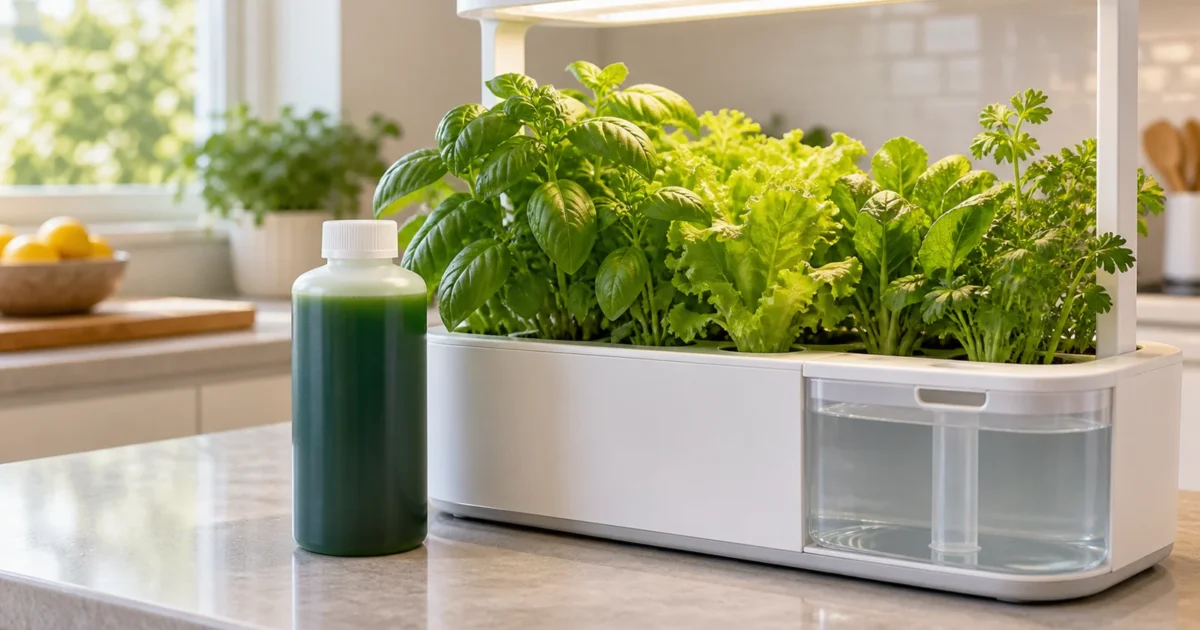
Whether you can use general hydroponic nutrients in a smart garden comes down to one test: does your system feed plants from a liquid reservoir, or does the nutrient already live inside the pod itself? That single distinction – not the brand name on the bottle – decides the answer, and it splits the major smart-garden brands into two clean groups. This guide walks through what “complete” actually means for a hydroponic nutrient, where AeroGarden, Gardyn, Rise Gardens, and Lettuce Grow land on that test, why Click & Grow is the hard exception, and the mixing and dosing habits that keep a substitution from becoming a mistake.
General Hydroponic Nutrients in a Smart Garden: The Short Answer
If your smart garden feeds plants by dissolving fertilizer in a water reservoir, a complete hydroponic nutrient program can often work as a substitute – but no brand covered here has published a statement that General Hydroponics or any other third-party nutrient is officially approved or warranty-safe. Treat it as “chemically workable, not manufacturer-endorsed” unless your own garden’s documentation says otherwise. Click & Grow’s Smart Soil pods are the one clear “no”: that system’s nutrients live in the pod, not the water, so a liquid swap doesn’t apply.
| Smart garden | How it feeds plants | Can you substitute general hydroponic nutrients? |
|---|---|---|
| AeroGarden | Liquid reservoir | Possible with a complete program, but AeroGarden’s own materials warn other fertilizers may clog the pump or misbalance the mix – not manufacturer-endorsed |
| Gardyn | Liquid reservoir, brand top-off routine | Chemically possible, but Gardyn’s own dosing-by-gallon routine is built around its plant food, not a third-party formula |
| Rise Gardens | Liquid or dry reservoir (brand-dependent) | Depends on which format your unit uses – Rise warns not to interchange dry and liquid nutrients in the same garden |
| Lettuce Grow | Liquid reservoir, Part A / Part B | Chemically possible, but the brand’s own two-part dosing and pH sequence is model-specific (Farmstand vs. Nook) |
| Click & Grow | Nutrient in the Smart Soil pod, not the water | No – liquid nutrients are unnecessary and not designed to reach the plant through the wick |
What “Complete” Actually Means – the UF/IFAS Test
The word “complete” is doing all the work in that table, and it has a specific meaning that has nothing to do with brand reputation. UF/IFAS Extension’s hydroponic nutrient guide (CV216) says plants require 17 essential elements, and that fertilizer management is about keeping every one of those elements adequate through the crop cycle – not just getting the nitrogen-phosphorus-potassium numbers to look reasonable on a label (UF/IFAS CV216). That’s the real test for any nutrient you’re considering: does it supply calcium, magnesium, and the trace elements, or just the big three.
General Hydroponics’ FloraSeries is a useful example of why a single bottle can fail this test. FloraSeries is a multi-part hydroponic program, and General Hydroponics is explicit that FloraBloom is meant to be used together with FloraMicro and FloraGro, not alone (General Hydroponics FloraSeries 3-Part Feed Program). FloraBloom by itself carries 0% nitrogen, so using only that one bottle would starve a plant of nitrogen even though the label looks like a legitimate hydroponic product (General Hydroponics FloraBloom). An ordinary houseplant fertilizer runs into the same problem from a different angle: Home Depot’s listing for a common liquid houseplant food shows an 8-7-6 analysis with directions for indoor foliage plants, but nothing on that page presents it as a complete water-culture formula carrying calcium, magnesium, and micronutrients the way a hydroponic program does. Don’t judge a bottle by its NPK numbers alone – check whether it’s sold and labeled as a complete hydroponic program.
Where Each Reservoir Brand Actually Stands
AeroGarden feeds from a liquid reservoir, which puts it in the “possible” column – but AeroGarden’s own Liquid Plant Food is described as a pH-buffered 4-3-6 blend with calcium and magnesium built specifically for AeroGarden models, and the company separately warns that other fertilizers might clog the pump or lack the right nutrient balance for its growing method (AeroGarden Liquid Plant Food). That’s a caution, not a ban – it just means a substitution is a decision you’re making, not one AeroGarden has signed off on.
Gardyn runs its own top-off routine, publishing plant-food dosing by gallon rather than a generic EC target (Gardyn Top-Off Guide). A complete hydroponic program is chemically usable in a Gardyn reservoir, but you’d be replacing a routine the brand has already tuned for its own plant food, not just swapping bottles.
Rise Gardens adds a format wrinkle worth knowing before you shop: Rise has moved from liquid nutrients to dry Sprout and Blossom formulas on newer units, and the company explicitly warns against interchanging dry and liquid nutrient formats in the same garden (Rise Switching From Liquid to Dry Nutrients). Check which format your specific Rise unit uses before assuming “liquid” applies.
Lettuce Grow doses with separate Part A and Part B nutrients, with Part B identified as calcium nitrate (Lettuce Grow Nutrients Explainer). The original Farmstand and the newer Farmstand Nook don’t share one dosing table – the Nook has its own initial and weekly dosing instructions, mixed in separate jars before it goes into the reservoir (Lettuce Grow Nook Nutrients). A generic hydroponic nutrient can chemically stand in for Part A and B, but you’d need to match the calcium and micronutrient load Lettuce Grow’s own formula provides, not just hit a similar NPK number.
None of this is a statement that General Hydroponics, or any other third-party brand, is approved for use in AeroGarden, Gardyn, Rise, or Lettuce Grow systems – no manufacturer source says that. It’s a statement that these four systems share the mechanical trait that makes general hydroponic nutrients usable in a smart garden reservoir in the first place, chemically if not officially.
Click & Grow Is the Exception: Why Smart Soil Pods Don’t Take Liquid Nutrients
Click & Grow breaks the pattern completely, and it’s the one system where the answer is a clean no. Its Smart Soil pods carry nutrients in the plug itself, not in a mixed liquid reservoir – Click & Grow says liquid nutrients are never necessary because Smart Soil already contains plant food (Click & Grow Liquid Nutrients). More specifically, Smart Soil includes slow-release nutrient balls carrying nitrogen, phosphorus, potassium, magnesium, calcium, and microelements, released over the growing cycle rather than dissolved on demand (Click & Grow Smart Soil Support). Pouring a general hydroponic nutrient into a Click & Grow tank doesn’t feed the plant the way it would in a true reservoir system – the water in that tank is a water source for the wick, not a nutrient solution.
This applies to Click & Grow’s standard, manufacturer-intended pods. If you’ve substituted your own growing medium in a heavily modified Click & Grow setup, you’re outside the manufacturer’s assumptions entirely, and this article’s answer – and Click & Grow’s own guidance – no longer cleanly applies.
How to Mix, Dose, and Adjust pH Without Guessing
If you’re working with a true reservoir system and a complete hydroponic program, a few procedural habits matter more than the exact brand you choose.
Dilute in water; never combine concentrates. General Hydroponics’ own instructions for FloraSeries say to add FloraMicro to fresh water first, then FloraGro, then FloraBloom, mixing thoroughly between each addition – and that undiluted concentrates should never be combined directly (General Hydroponics FloraSeries 3-Part Feed Program). Mixing concentrated parts together before they hit water risks forming precipitates you can’t undo.
Mix nutrients first, then check pH. General Hydroponics recommends checking and adjusting pH and EC/PPM only after all nutrient components are mixed in, and Oklahoma State Extension’s EC and pH guide follows the same order – manage EC after fertilizer is added, then bring pH into range (Oklahoma State Extension EC and pH Guide). Adjusting pH before the nutrient is fully mixed in just means adjusting it again later.
Don’t chase a universal EC or ppm number. Feed charts are recommendations, not fixed targets – General Hydroponics itself frames its charts as a starting point that may need adjustment for your environment, and Missouri Extension notes that EC tells you how many dissolved ions are in solution, not whether those ions are in the right ratio to each other (Missouri Extension Hydroponic Nutrient Solutions). A reading that looks “on target” can still mean a nutrient imbalance.
Follow your specific garden’s manual for top-offs, not a generic rule. This is the one place where professional opinions and manufacturer routines genuinely diverge, so don’t apply one blanket instruction across every brand. AeroGarden’s AeroVoir accessory, for example, is water-only – AeroGarden says plant food should not be added directly to that tank (AeroGarden AeroVoir). Gardyn takes a different approach: if you accidentally topped off with plain water, Gardyn’s own guidance says not to add extra plant food to “catch up” – just resume the normal routine at the next scheduled top-off (Gardyn Top-Off Guide). Your garden’s own manual is the correct source here, not a general hydroponics rule of thumb.
A Few Mistakes Worth Avoiding
Using FloraBloom alone. Covered above, and worth repeating because it’s the single most common way a “complete nutrient” purchase turns out not to be one – 0% nitrogen in a bottle that looks like a full fertilizer.
Testing pH with dye-based test strips. Missouri Extension recommends against pH test strips in nutrient solution because fertilizer dyes can throw off the color reading; a probe stored properly (in storage solution or pH 4 buffer, not plain water) reads more reliably (Missouri Extension Hydroponic Nutrient Solutions).
Assuming softened water is automatically better. Rise’s own water-quality guidance says softened water can lack calcium and magnesium and may run high in sodium, while hard water complicates pH control – neither is a clear upgrade over ordinary tap water for most home setups (Rise Switching From Liquid to Dry Nutrients).
Treating your USDA hardiness zone as relevant here. It isn’t. The USDA Plant Hardiness Zone Map is built from average annual extreme minimum winter temperature – it says nothing about indoor reservoir chemistry, grow-light output, or which nutrient your countertop garden can use (USDA Plant Hardiness Zone Map). If you’ve seen zone advice attached to a nutrient question anywhere, it’s a mismatch.
Water Quality Is Regional – Don’t Over- or Under-React
How much you need to worry about your tap water depends on where you fall on the spectrum between casual home growing and something closer to a commercial setup. UNH Extension’s home-hydroponics guidance is relatively relaxed: ordinary drinkable municipal or well water is generally fine for home hydroponic growing, while commercial growers need more precise water-chemistry data than a home gardener typically tracks (UNH Extension: Hydroponics at Home). Oklahoma State Extension takes a more testing-oriented stance, recommending that source water be checked for pH, EC, alkalinity, and dissolved salts – sodium, calcium, magnesium, bicarbonates, chlorides, and sulfates – especially where those results affect a crop (Oklahoma State Extension EC and pH Guide).
Both are right for their audience. Most home smart-garden owners can start with plain drinkable tap water if their unit’s manual allows it. If you’re seeing persistent pH or EC problems, you’re on a softened or unusually hard water supply, or you’re growing something you don’t want to risk, that’s when testing or switching your water source earns its cost.
What This Costs Over Time
Deciding to use general hydroponic nutrients in a smart garden is a recurring-purchase decision, the same as AeroGarden’s, Gardyn’s, Rise’s, or Lettuce Grow’s own plant food – not a one-time hardware decision. Prices move often enough that any number printed here would be stale within months, so rather than quote figures that won’t hold up, run your specific setup through the Pod & Nutrient Cost calculator, which compares OEM and generic nutrient costs for your exact deck size and refresh schedule. A cheaper per-ounce nutrient is worth considering, but cost alone isn’t the decision test – completeness and your system’s own documentation come first.
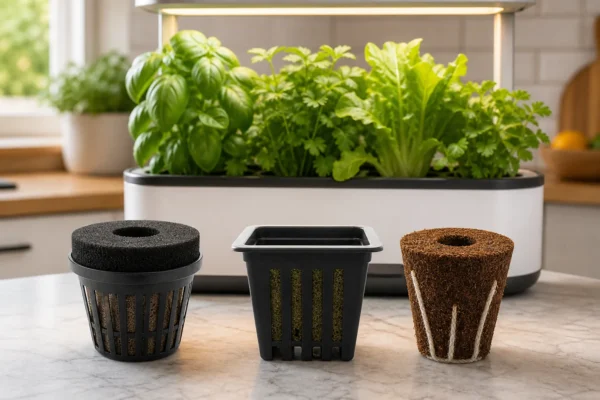
If you’re still confirming what kind of pod or deck you’re working with before you worry about nutrients at all, Smart Garden Pod Types covers the round, square, and soil-wick formats, and Smart Garden Proprietary Pods breaks down which brands lock you into more than just a pod shape. AeroGarden owners specifically can see the fuller aftermarket picture, pods included, in Which Pods Fit My AeroGarden?
Can I use General Hydroponics nutrients in my AeroGarden?
Possibly, in the sense that AeroGarden feeds from a liquid reservoir and a complete hydroponic program is chemically usable there. But AeroGarden’s own materials warn that other fertilizers might clog the pump or lack the right balance for its system, so treat any substitution as unendorsed, not officially sanctioned.
Can I put liquid hydroponic nutrients in a Click & Grow?
No, not for standard Smart Soil pods. The nutrients are already built into the pod as slow-release nutrient balls, and Click & Grow says liquid nutrients are never necessary because of that design.
Is FloraBloom by itself a complete nutrient?
No. FloraBloom is one part of General Hydroponics’ three-part FloraSeries program and carries 0% nitrogen on its own – it’s meant to be combined with FloraMicro and FloraGro, not used alone.
Should I top off my reservoir with plain water or more nutrient solution?
It depends on your specific garden, not a universal hydroponics rule. AeroGarden’s AeroVoir accessory takes water only; Gardyn says not to add extra plant food to “catch up” after an accidental plain-water top-off. Follow your unit’s own manual rather than a generic instruction.
Do I need to track EC or ppm numbers in a smart garden?
There’s no single ppm or EC target that applies across every smart-garden brand. Mix your nutrients fully first, then check and adjust pH and EC as your nutrient’s own label or your garden’s manual directs, and treat a “good” EC reading as evidence of dissolved ions, not proof every nutrient is balanced.
Where can I check what a nutrient switch actually saves?
Run your setup through the Pod & Nutrient Cost calculator for a comparison based on your exact deck size, rather than relying on a price printed in an article that may already be out of date.
Sources
- UF/IFAS CV216 – Hydroponic Nutrient Solutions
- UNH Extension: Hydroponics at Home
- General Hydroponics FloraSeries
- General Hydroponics FloraBloom
- General Hydroponics FloraSeries 3-Part Feed Program
- AeroGarden Liquid Plant Food
- AeroGarden AeroVoir
- Click & Grow Liquid Nutrients
- Click & Grow Smart Soil Support
- Gardyn Top-Off Guide
- Rise Switching From Liquid to Dry Nutrients
- Lettuce Grow Nutrients Explainer
- Lettuce Grow Nook Nutrients
- Oklahoma State Extension EC and pH Guide
- Missouri Extension Hydroponic Nutrient Solutions
- USDA Plant Hardiness Zone Map
The bottom line
Whether you can use general hydroponic nutrients in a smart garden depends on how the system feeds its plants, not on brand loyalty. AeroGarden, Gardyn, Rise Gardens, and Lettuce Grow all dissolve fertilizer in a water reservoir, which makes a complete hydroponic program chemically workable – with the honest caveat that none of these manufacturers has published approval for a third-party nutrient, so you’re making an unendorsed substitution, not following a sanctioned one. Click & Grow’s Smart Soil pods are the clear exception: the nutrient is already in the plug, and liquid feeding doesn’t apply. Whichever system you own, dilute concentrates in water rather than combining them, mix nutrients before adjusting pH, and follow your own garden’s manual for top-offs and water quality rather than a one-size-fits-all hydroponics rule. Then check the real year-round cost with the Pod & Nutrient Cost calculator before you commit to a switch.
More in this guide
- Is AeroGarden Discontinued? What Actually Happened, and What Still Fits Is AeroGarden Discontinued? What Actually Happened, and What Still Fits If you typed is AeroGarden discontinued into a search bar because your…
- Smart Garden Pod Types: Round, Square, and Soil-Wick Explained Smart Garden Pod Types: Round, Square, and Soil-Wick Explained Shop for refill pods for a countertop hydroponic garden and you’ll find dozens…
- Smart Garden Proprietary Pods: Which Brands Lock You In (And Which Don’t) Smart Garden Proprietary Pods: Which Brands Lock You In (And Which Don’t) The sticker price on a countertop hydroponic garden is not…
- Which Pods Fit My AeroGarden? Compatible Pods + Nutrients Guide If your AeroGarden pods are getting harder to find – or you have hit the unit’s “buy more pods” wall and balked…
Related guides
Is AeroGarden Discontinued? What Actually Happened, and What Still Fits
Is AeroGarden Discontinued? What Actually Happened, and What Still Fits If you typed is AeroGarden discontinued into a…
Smart Garden Pod Types: Round, Square, and Soil-Wick Explained
Smart Garden Pod Types: Round, Square, and Soil-Wick Explained Shop for refill pods for a countertop hydroponic garden…
Smart Garden Proprietary Pods: Which Brands Lock You In (And Which Don’t)
Smart Garden Proprietary Pods: Which Brands Lock You In (And Which Don’t) The sticker price on a countertop…