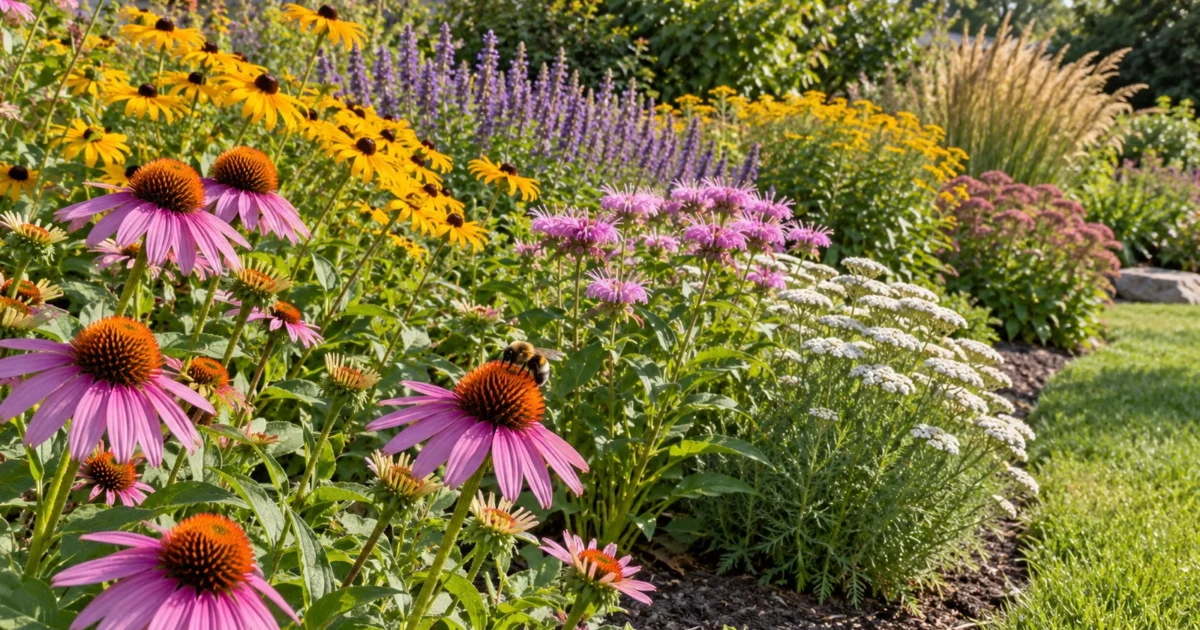
Pollinator Plants: How to Choose Ones That Fit Your Zone, Sun, and Soil
The tag on the plant says “pollinator friendly,” the nursery says it’s hardy in your zone, and by August it’s leggy, rotted, or gone. That’s the usual story behind a failed bed of pollinator plants: each label answered one question, and nobody checked the other four.
This guide puts the questions in order: cold hardiness, native range, sun, soil moisture, and bloom timing. Then it covers what usually goes wrong, what the work and the materials cost, when to do it yourself, and when a plant or a whole bed should be replaced. Where professional opinions vary by site, we say so.
The Short Answer
- Treat zone as the first filter, not the last. USDA’s map covers winter cold only.
- Then narrow by native range, sun, soil moisture, and bloom season. NWF’s Native Plant Finder narrows native plants by ZIP code. The Xerces Society separately publishes regional native plant lists by state.
- Plan for the whole year. Adult bees and butterflies need flowers from spring through fall, and caterpillars need host plants.
- Expect year one to look modest. Natives often spend their first season or two building roots.
- Keep retail labels in their lane. A store listing can tell you a price. It can’t tell you a plant is native, a straight species, or good for pollinators.
Pollinator Plants Work as a Habitat System, Not a Single Plant
A pollinator planting is a small habitat, and a habitat has several parts that all have to work. Flowers are only one of them.
Adult food and caterpillar food are different jobs. Cornell Cooperative Extension recommends diverse flowering species that bloom in succession from spring through fall, planted in drifts of at least three plants of each species so pollinators can find them efficiently (Cornell Cooperative Extension). The National Wildlife Federation’s Native Plant Finder covers the other half: it ranks ZIP-code-specific native plants by how many butterfly and moth species use them as caterpillar hosts (NWF Native Plant Finder).
Nesting and shelter count too. EPA recommends native flowering plants suited to the local climate and region, clean water, reduced mowing, avoiding pesticides and herbicides, leaving some ground undisturbed for ground-nesting pollinators, and leaving plant stalks and organic material until pollinators emerge in spring (EPA Pollinator Flier). Xerces adds that roughly 70% of native bees nest in the ground, and that habitat should include stable bare or sparsely vegetated soil, leaf litter, stems, dead wood, and protected overwintering areas (Xerces Nesting Resources).
Water moves through the bed, too. In an ordinary bed, rain or irrigation soaks through mulch and soil to the roots. A rain garden is different: EPA describes it as a shallow planted area that collects stormwater runoff and filters it through soil, sand, or gravel mixtures (EPA Green Infrastructure). EPA WaterSense says water-smart landscapes can reduce runoff and irrigation needs (EPA WaterSense).
The Five Filters, in Order
Work through these in sequence. Each one removes plants the previous one let through.
| Filter | The question | Where to get the answer | What it can’t tell you |
|---|---|---|---|
| 1. Cold hardiness | Will it survive your winter minimum? | USDA Plant Hardiness Zone Map | Heat, drought, soil, pollinator value, yard-scale microclimate |
| 2. Native range | Is it native to your region or ecoregion? | NWF Native Plant Finder, by ZIP code. Xerces regional native plant lists, by state. | Whether your particular yard suits it |
| 3. Sun | How many hours of direct light does the spot get? | Your own observation during the growing season | Nothing, but it must be measured, not guessed |
| 4. Soil moisture and drainage | Wet, average, or dry, and does it drain? | The Lady Bird Johnson Wildflower Center database filters by soil preference; a soil test helps | Rain-garden conditions (see below) |
| 5. Bloom season | Is something flowering from spring through fall? | Cornell’s succession guidance; the Lady Bird Johnson Wildflower Center database filters by bloom time | Host-plant value on its own |
Filter 1: zone. USDA ARS says the Plant Hardiness Zone Map is based on the average annual extreme minimum winter temperature, and that wind, soil type, soil moisture, humidity, pollution, snow, and winter sunshine can also greatly affect whether a plant survives (USDA ARS). The map is a cold-survival tool, and pollinator value is outside what it measures; that last point is our reading, not USDA’s wording. A plant can be hardy in your zone and still be a poor fit for your site, region, or target pollinator. For the zone basics, see our USDA hardiness zone guide.
Filter 2: native range. Two lookups do most of the work here. NWF’s Native Plant Finder asks for your ZIP code and returns only plants native to your specific area (NWF Native Plant Finder). Xerces publishes regional native plant lists that can be filtered by state (Xerces Plant Lists). That same Xerces page points to the Lady Bird Johnson Wildflower Center’s Native Plant Database, which it describes as filterable by bloom time, light requirements, and soil preference, so that database can help with filters three through five.
Filter 3: sun. According to Oklahoma State Extension, full sun is generally six or more hours of direct light a day, and part shade commonly means roughly three to six hours with protection from harsher midday sun (Oklahoma State Extension). Count the hours in the spot itself. A full-sun prairie plant in a four-hour site may stretch, flop, flower poorly, or disappear over time.
Filter 4: soil. A dry-site species can rot in wet clay, and a moisture-loving one can crisp in fast-draining soil. University of Minnesota Extension recommends soil testing every three to five years and when converting a lawn to a garden bed (UMN Extension).
Filter 5: bloom season. A bed that looks good for three weeks in June and has nothing in April or October is incomplete habitat. Cornell’s advice to bloom in succession is the test.
Once you know your conditions, you can filter plants by your USDA zone in our Explore plant finder. Our plant finder covers the zone step only, so keep going through filters two to five with the lookups named above or your local extension office.
One caution on rain gardens
A rain garden is a drainage feature, not just a flower bed. The research behind this guide found that plants in a rain-garden basin may need to tolerate both temporary flooding and dry periods after the water drains. So a plant with the right zone and sun is not automatically right for a basin. Check that plant against the basin’s conditions, not just the yard’s.
The cultivar question
Cultivars are the most argued-over part of choosing pollinator plants, and the honest answer is “it depends on the plant.”
Cornell warns that double-flowering plants may not provide enough pollen or nectar. Penn State’s Center for Pollinator Research warns that some cultivars lack meaningful pollen and nectar resources (Penn State Center for Pollinator Research). But the answer isn’t “all cultivars are bad.” According to Mt. Cuba Center’s native-plant trials, some native cultivars have documented horticultural and ecological value (Mt. Cuba Top Performers).
So here’s a workable rule, and it’s ours rather than any one source’s. Straight species are often the safer default when you have no cultivar-specific evidence. Be wary of double, sterile, or heavily altered flowers. A cultivar with documented pollinator use from a credible trial or extension source can be acceptable.
The same caution applies to big-box plants. A retail listing, such as a generic “Echinacea” on a Monrovia pot, can serve as a price example. It doesn’t tell you the plant is a straight species, native to your region, drought-tolerant in your yard, or valuable to pollinators. Check the botanical identity and cultivar name before you assume.
The Most Common Problems, in Priority Order
There’s no reliable national data on how often pollinator plantings fail. Angi and HomeAdvisor are useful for cost context, not for biological failure rates. So the order below is our own practical priority list, not a ranking that any source publishes, and it is not a frequency table. Where an item rests on a source, the source is cited in that item.
- Trusting the zone map alone. The symptom: the plant is “hardy” by zone but missing from local native-plant lists, or struggling in your yard.
- Wrong sun. The symptom: stretching, flopping, or poor flowering in the first season.
- Wrong moisture or drainage. The symptom: rot in wet clay or crisping in fast-draining soil.
- Misreading year one. USDA NRCS says establishment maintenance is key, watering is typically required in the first year, and native plants may spend the first and possibly second season building roots instead of producing showy growth or flowers (USDA NRCS Pollinator Gardens). The symptom: plants are alive but small, wilt between rains, or barely bloom.
- Weeds and poor site preparation. NRCS warns that seed establishment requires vigilance against existing vegetation, roots, and weed seed. Xerces and UNH Extension both treat site preparation as one of the most important parts of wildflower establishment (Xerces Organic Site Preparation, UNH Extension).
- Bloom gaps. Covered above.
- Pesticides on the plant you bought. Xerces says plants marketed as pollinator-friendly may still have been treated with pesticides, and advises asking vendors about growing practices and avoiding neonicotinoids and similar systemic insecticides (Xerces Bee-Safe Nursery Plants).
- Low-value cultivars. See the section above.
- Over-cleaning and over-mulching. Xerces warns that thick wood mulch over ground-nesting areas and tilling in spring or fall can destroy nesting habitat (Xerces Garden Garbage).
- Invasive or aggressive plants. University of Maryland Extension says to avoid invasive species such as butterfly bush (UMD Extension). Pollinator Partnership warns that seed mixes and garden-center plants may include species that are invasive where they’re sold (Pollinator Partnership).
- Browsing. Xerces says deer, gophers, and rabbits can be problematic in native plantings and recommends protectors for young plants where browsing pressure is present (Xerces Managing Pests).
Three more traps, from single sources
These came up in one research pass each, so we attribute them. Penn State says fertilizer isn’t recommended for native plants in pollinator gardens, and its FAQ advises against enriching soil for sun-loving native perennials (Penn State FAQ). On milkweed, Xerces recommends only locally native species and does not recommend tropical milkweed, because it can stay evergreen in warm areas, allow parasite buildup, and potentially disrupt monarch migration (Xerces Milkweed FAQ). And UF/IFAS says small wildflower seed needs strong seed-to-soil contact after site preparation (UF/IFAS).
Generic seed mixes
A national wildflower mix isn’t automatically a regional one. The research compared two examples: American Meadows’ Western Pollinator mix is marketed across a broad multistate region, while Prairie Moon’s Pollinator-Palooza is described as Midwest-oriented (American Meadows Western Pollinator Mix, Prairie Moon Pollinator-Palooza). Even the Midwest one isn’t universally local. Before buying a mix, check your local extension office, Xerces, native plant societies, and regional native nurseries. Professional opinions vary here: for a casual ornamental bed a broad regional mix may be acceptable with caution, while ecological restoration, rights-of-way, or conservation-minded work calls for local ecotypes from local native nurseries.
Mulch, bare soil, and cleanup: it depends on the stage
Two pieces of good advice seem to collide, and they only conflict if you ignore timing.
During conversion. Turning lawn or weedy ground into a bed can legitimately involve disturbance. The sources describe smothering, sod removal, solarization, shallow cultivation, or herbicide treatment, depending on the site (Xerces Organic Site Preparation, NC State Extension). Professional opinions vary on herbicide versus non-chemical weed control, so check your local extension’s recommendation for your weeds.
After establishment. EPA’s “avoid disturbance” advice fits here: protect nesting and overwintering habitat. On mulch, the guidance is conditional rather than absolute. Xerces’ Oregon habitat-kit guidance says wood chips or similar mulch can help suppress weeds and retain moisture after planting (Xerces Oregon Habitat Kits). Xerces’ nesting guidance says to leave stable bare or sparsely vegetated soil. A reasonable way to do both, which is our reading and not a quoted rule: mulch young plug plantings where weeds and moisture are the problem, and leave some patches of bare soil for ground nesters.
Fall cleanup. According to Xerces, leave dead stems standing over winter, then prune in early spring so stem-nesting bees keep usable nesting sites. Its guides give cutting heights of roughly 8 to 12 inches or 8 to 24 inches (Xerces Habitat Assessment Guide, Xerces Natural Nesting Habitat).
What You Actually Need, and What It Costs
A small bed doesn’t need much. Home Depot’s pollinator-garden guide lists a shovel, hoe, trowel, organic soil and compost, mulch, and a hose or watering can as basic tools and materials (Home Depot EcoActions). Treat that as a practical retailer checklist, not an authority on plant selection. Retailers are good sources for prices; they shouldn’t outrank extension or Xerces on horticulture.
A $30 starter set can cover small containers or a plug bed if you already own a hose or watering can.
A $100 to $200 mid-tier kit adds soil testing, bypass pruners, a hand weeder, a kneeling pad, plant tags, a soaker hose, and protectors where browsing is a problem. Cost items we can cite:
| Item | Cited price | Source |
|---|---|---|
| Extension soil test | $10 (Penn State), $22 (UMN), $26 (Michigan State) | Penn State Soil Testing, UMN Soil Testing Lab, MSU Shop |
| 50-foot soaker hose | $24.99 (Hammond Hardware, Teknor Apex) | Hammond Hardware |
| Bagged mulch, 2 cu ft | About $3.33 to $3.57 at Home Depot | Home Depot Mulch |
| Plants from a curated pack | $63 for nine plants in 2.5-inch-wide pots (Prairie Moon) | Prairie Moon Summer Pollinator Pack |
| Seed mix (one example) | $21 per 500 square feet up to $797 per acre (Prairie Moon Pollinator-Palooza) | Prairie Moon Pollinator-Palooza |
Prices change by store and week, and seed mixes vary widely by species, region, weight, and sale status, so don’t generalize from any one mix.
Professional-grade tools are justified by scale, not by a small bed. For large lawn conversions, rain gardens, or repeated maintenance, upgrades include long-handled digging tools, loppers, a wheelbarrow, irrigation parts, and possibly rented sod cutters or augers. The logic is labor: HomeAdvisor reports gardeners commonly averaging $50 to $100 per hour (HomeAdvisor Gardeners), so better tools pay off when they prevent paying that rate across multiple beds.
What a hired installation runs
Angi reports professional flowerbed installation at about $1,000 to $3,000, or $10 to $20 per square foot (Angi Flowerbed Cost). HomeAdvisor reports flower-garden installation at $1,000 to $3,000, and broader landscape installation at $1,248 to $6,067, averaging $3,516 (HomeAdvisor Landscaping Cost). HomeAdvisor says it compiles those figures from cost surveys filled out by homeowners who used it to find pros. Our own caveat: none of these numbers is specific to pollinator plantings, so read them as budget context. For labor rates, Angi reports lawn-care labor from $35 to $190 per hour, with many homeowners paying $35 to $70 (Angi Lawn Care).
Do It Yourself, Replace, or Hire Help
Do it yourself, or hire someone
The research sorts the work into rough tiers.
- Easy. Measure sun exposure, read plant labels carefully, group plants by similar water and light needs, set up a temporary watering plan, and fill small bloom gaps. NRCS supports first-year watering, and Cornell supports drifts and bloom succession.
- Moderate. Replace a mismatched plant, relocate plants into better sun or moisture, divide or reduce aggressive spreaders, add missing spring or fall bloomers, and manage weeds without damaging native roots. Virginia Cooperative Extension says weed control should start with identifying the weed and understanding its life cycle (Virginia Cooperative Extension).
- Hard. Converting the site: removing turf, suppressing persistent perennial weeds, preparing a seedbed, fixing compaction, reshaping runoff, or building a meadow from seed.
- Call a professional. Regrading near foundations, routing roof or street runoff, a rain garden that affects drainage, retaining walls, tree removal, large hardscape, permanent irrigation, rights-of-way, HOA constraints, or municipal stormwater requirements. Angi notes that permits are usually tied to major excavation, retaining walls, or permanent irrigation systems.
Professional opinions vary by site on all of these, especially drainage work and site preparation, so treat this as a starting point and check local rules.
When to replace a plant, and when to be patient
Not every struggling plant needs to go.
- Replace the plant when the mismatch is narrow and site-specific: a full-sun plant in part shade, or a dry-site plant in wet soil. The fix is usually relocation or substitution, not a new bed.
- Be patient with the plan when year-one plants are alive but underwhelming. NRCS says full establishment can take up to two years. The line is death versus patience: a dead plug gets replaced, while a small, rooted native may just need water, mulch management, and weed relief.
- Redo site preparation when weeds, turf, or invasives dominate the planting.
- Redesign when the bed has no seasonal succession, such as a summer-only bloom window.
- Swap out low-value cultivars when pollinator support is the goal and insect visits are poor, especially double or sterile flowers.
- Hire help or redesign the project when drainage, grading, runoff capture, hardscape, or municipal rules are involved.
What to Do Next
Start with your own conditions: write down your zone, count your sun hours in the spot, and note whether the soil stays wet or dries fast. Then enter your ZIP code in NWF’s Native Plant Finder. Xerces’ regional native plant lists, filtered by state, are a second place to look. For help measuring a spot, see our garden conditions guide, and for the zone step see the USDA hardiness zone guide.
Does my USDA zone tell me which pollinator plants to buy?
No. USDA ARS says the map is based on average annual extreme minimum winter temperature. It doesn’t answer heat, drought, soil, pollinator value, or microclimate questions, so use it only to rule out plants that can’t survive your winters.
How much sun do pollinator plants need?
It depends on the species. According to Oklahoma State Extension, full sun is generally six or more hours of direct light a day and part shade commonly runs roughly three to six hours. Match each plant’s label to the hours your spot actually gets.
Are native cultivars bad for pollinators?
Not automatically. Penn State’s FAQ says it depends on how the cultivar was derived, and points gardeners to Mt. Cuba Center, whose research team evaluates native plants and related cultivars for horticultural and ecological value. Straight species are a safer default when you have no evidence either way.
Why is my new native planting so small?
USDA NRCS says native plants may spend their first and possibly second season building roots rather than producing showy growth, and that watering is typically required in the first year. Alive but small is not the same as failed.
Can I buy pollinator plants from a garden center safely?
Ask first. Xerces says plants marketed as pollinator-friendly may still have been treated with pesticides, and advises asking vendors about growing practices and avoiding neonicotinoids and similar systemic insecticides.
Should I mulch a pollinator bed?
It depends on the stage. Xerces’ Oregon habitat-kit guidance says mulch can suppress weeds and retain moisture after planting, while Xerces also advises leaving stable bare or sparsely vegetated soil for ground-nesting bees. Mulch young plantings and leave some bare patches.
Sources
- USDA ARS: How to Use the Maps
- NWF Native Plant Finder
- Xerces Society: Pollinator-Friendly Plant Lists
- Cornell Cooperative Extension: Creating a Pollinator-Friendly Garden
- EPA: Pollinator Flier
- Xerces Society: Nesting Resources
- EPA: Types of Green Infrastructure
- EPA WaterSense: Landscaping Tips
- Oklahoma State Extension: Understanding Your Plants’ Needs
- UMN Extension: Soil Testing for Lawns and Gardens
- Penn State Center for Pollinator Research: Choosing Plants
- Mt. Cuba Center: Top Performers
- USDA NRCS: Pollinator Gardens
- Xerces Society: Organic Site Preparation for Wildflower Establishment
- UNH Extension: Establishing a Wildflower Meadow from Seed
- Xerces Society: Bee-Safe Nursery Plants
- Xerces Society: Garden Garbage
- UMD Extension: Pollinator Gardens
- Pollinator Partnership: Plants to Help Pollinators
- Xerces Society: Managing Pests
- Penn State: Pollinator Habitat Certification FAQ
- Xerces Society: Milkweed FAQ
- UF/IFAS: Wildflower Seed Establishment
- American Meadows: Western Pollinator Wildflower Seed Mix
- Prairie Moon: Pollinator-Palooza Seed Mix
- NC State Extension: Pollinator Garden Site Preparation
- Xerces Society: Oregon Habitat Kits
- Xerces Society: Habitat Assessment Guide
- Xerces Society: Natural Nesting Habitat
- Virginia Cooperative Extension: Maintaining Native Plants
- Home Depot: Pollinator Garden How-To
- Penn State: Soil Testing
- UMN Soil Testing Lab: Lawn and Garden
- MSU Shop: Home Lawn and Garden Soil Test Mailer
- Hammond Hardware: Teknor Apex Soil Soaker
- Home Depot: 2 cu ft Bagged Mulch
- Prairie Moon: Summer Pollinator Power Pack
- HomeAdvisor: Gardeners
- Angi: Flowerbed Installation Cost
- HomeAdvisor: Landscaping Cost
- Angi: Lawn Care Cost
Educational content only. Not a substitute for licensed professional or extension-office advice. Local climate, frost timing, and site conditions vary by yard and region. Use of any guidance from this guide is at your own risk.
Get the homeowner’s plant-shopping starter checklist — the questions to answer about your site before you buy anything. [Free download — enter your email]