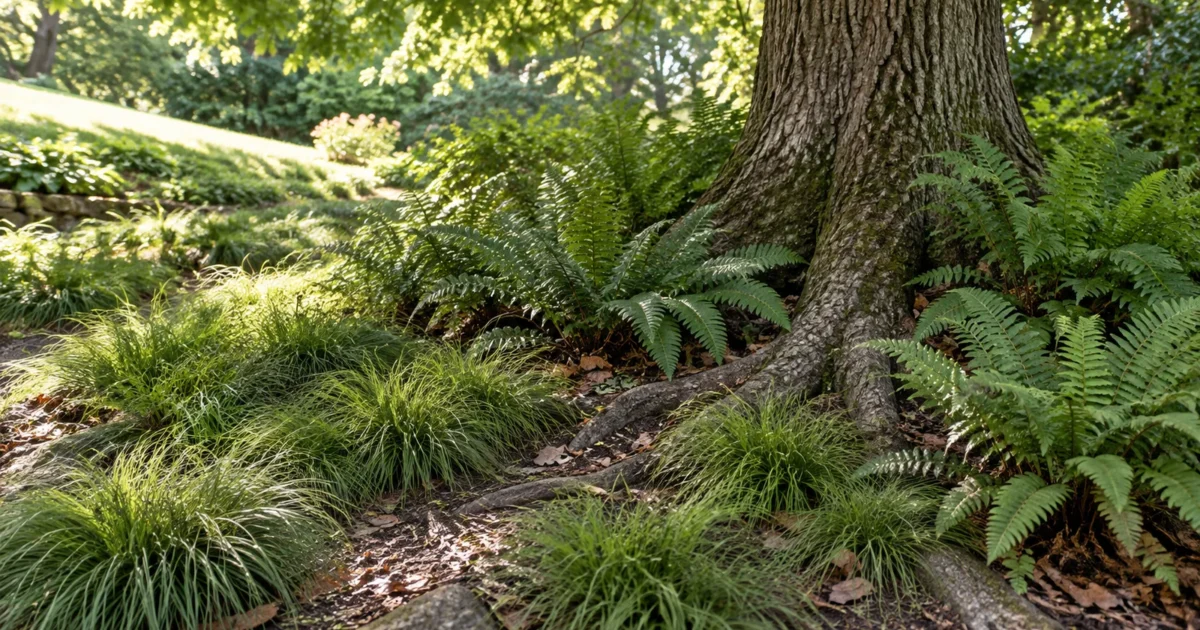
Plants for Dry Shade: The Hardest Spot in the Garden, and What Takes It
The bed under the maple looks like it should be easy. It’s shady, so you buy shade plants, and by midsummer they’re crisp, stunted, or gone. That’s the pattern behind most searches for plants for dry shade: the plant tag said “shade,” and nobody mentioned that the soil under a mature tree is also some of the driest ground in the yard.
This guide covers why dry shade is harder than ordinary shade, which plants for dry shade have solid extension-source support (with the caveats that go with each), which popular groundcovers to screen before you buy, and how to plant under trees without hurting the tree. One limit up front: any list has a blind spot for tree roots, and we’ll say exactly where.
Plants for Dry Shade Start With Two Problems, Not One
Dry shade is an intersection. A north-facing bed can be shaded without being dry, and a sunny slope can be dry without being shaded. (We cover those separately in what actually grows in a north-facing bed and plants for a dry sunny slope.) Dry shade is both at once, and under established trees there’s often a third problem stacked on top.
Penn State Extension says plants under trees “must tolerate shade, dry soil, and varying degrees of moisture and sunlight,” and adds that “tree roots absorb the available moisture and, when competing with other plants, always win” (Penn State Extension). University of Missouri Extension describes the same mechanism: shaded plants deal with low light and poor air circulation and compete with the trees for water and nutrients, and shallow-rooted trees such as maples and willows are particularly troublesome (Missouri Extension).
That is why a plant can be labeled shade-tolerant and still fail here. The shade rating answers the light question. It doesn’t answer the moisture question, and it certainly doesn’t answer the root question.
What “Shade” Means on a Plant Tag
“Shade” isn’t one condition, and tags rarely say which one they mean. Maryland Extension defines full shade as three or fewer hours of sunlight a day, while NC State’s plant records define deep shade as less than two hours to no direct sunlight (University of Maryland Extension, NC State Extension). A plant that does well in the bright, open shade of a fence line may sulk in deep shade under a spruce.
Shade also moves. NC State notes that shade and light intensity change with time of day, season, slope, and tree growth, so a spot that’s sunny in winter can be heavily shaded once the trees leaf out (NC State Extension). Watch the site during the growing season before you buy a flat of anything.
Your USDA hardiness zone is a separate question again. USDA ARS says the 2023 Plant Hardiness Zone Map is based on the average annual extreme minimum winter temperature (USDA ARS). It measures winter cold only, so it tells you nothing about drought, shade, or root competition. Use it to rule out plants that can’t survive your winters, and nothing more. (If your zone shifted recently, see why your USDA hardiness zone changed in 2023.)
Plants for Dry Shade With the Best Extension Support
These are the plants for dry shade we’d start with, each backed by a university or extension source that ties it to shade and dry or drought conditions. Read the third column. Most of these are “once established,” not “instantly.”
| Plant | Type | What the sources say, and the caveat |
|---|---|---|
| Pennsylvania sedge (Carex pensylvanica) | Groundcover / lawn alternative | NC State says its ideal location is dry to moist shade and that it forms a turf alternative in dry shade (NC State Extension). Iowa State calls it one of the best sedges to use in a lawn setting and says it grows in partial to full shade (Iowa State Extension). UNH Extension cautions that growth in dry shady spots is slower and less robust than in richer soil. |
| Epimedium / barrenwort (Epimedium) | Groundcover | NC State says deep shade and drought are not an issue for established plants and that it can compete with tree roots. It spreads slowly, so don’t expect instant coverage. |
| Christmas fern (Polystichum acrostichoides) | Evergreen fern | NC State recommends organically rich, dry to medium, well-drained soil in part to full shade. Clumps spread slowly, so it isn’t a fast carpet. |
| White wood aster (Eurybia divaricata) | Late-season flower | NC State says it prefers partial shade in medium to dry, well-drained soil and tolerates shade, deer, and drought. Best for open shade and woodland edges. |
| Mapleleaf viburnum (Viburnum acerifolium) | Shrub | NC State’s mapleleaf viburnum page describes it as an understory plant in moist to dry woodland settings and as drought tolerant once established (NC State Extension). It’s a shrub, not a groundcover. |
| Fragrant sumac (Rhus aromatica) | Shrub | NC State’s fragrant sumac page lists full sun to partial shade and moist to dry, well-drained soils (NC State Extension). It can reach 2 to 6 feet tall and 6 to 10 feet wide and spreads by suckers, so give it room. |
Two plants in that table deserve a closer look. Pennsylvania sedge is the one to try first for a groundcover or lawn substitute, and the sources for it are unusually consistent across states. Epimedium is the classic pick where roots are the main complaint, but Maryland Extension lists it among non-native groundcovers, and it earns its keep slowly. Plan for a couple of seasons.
Plants That Work, but Not for the Driest Spot
Some plants show up on dry-shade lists because a database lists drought or dry-soil resistance. Their preferred conditions are a little kinder than that. They can work in drier shade once established, but they’re not the plants to put in the worst, most root-choked corner.
- American alumroot (Heuchera americana). NC State lists it as drought-tolerant, but also says to plant it in moist, rich soils in shade to part sun. Think of it as a dry-ish, once-established foliage perennial, not a dry-shade workhorse.
- Woodland phlox (Phlox divaricata). NC State recommends partial to full shade in moist, high-organic, well-drained soil while listing drought and dry-soil resistance. Wisconsin Horticulture says the same: best in moist, rich woodland soil, tolerant of dry soil once established.
- Hellebore (Helleborus spp.). NC State’s stinking hellebore (Helleborus foetidus) page says it is best grown in partial to full shade and is drought-tolerant once established (NC State Extension). It is also listed by the ASPCA as toxic to dogs, cats, and horses (ASPCA), so think twice if pets browse the bed.
Three more plants turned up in single sources. NC State’s Allegheny spurge (Pachysandra procumbens) page says it grows under trees and shrubs and lists resistance to drought and heat (NC State Extension). NC State’s eastern columbine (Aquilegia canadensis) page says it prefers partial shade and lists good drainage and occasionally dry soil among its soil conditions (NC State Extension). Treat both as “worth checking against a second local source” rather than proven picks. The same source lists lily-of-the-valley for heavy shade and dry soil, but the ASPCA lists it as toxic to dogs, cats, and horses (ASPCA), which makes it a poor casual recommendation for a family yard.
A note on pet safety in general: the ASPCA says its list isn’t all-inclusive. If a plant isn’t on it, that means unknown, not safe. Our pet-safe plants guide covers how to read it.
What to Screen Before You Plant a Shade Groundcover
Several groundcovers appear on generic shade lists and are a poor idea in many regions. The mistake isn’t saying they’ll grow in shade. It’s recommending them without checking local invasive guidance.
Maryland Extension says English ivy spreads by seed and runners, blocks sunlight as a groundcover, and can damage trees when it climbs them (University of Maryland Extension). Its groundcover page discourages English ivy, periwinkle, Japanese spurge (Pachysandra terminalis), bugleweed, creeping Jenny, creeping lilyturf, European lily-of-the-valley, and wintercreeper (University of Maryland Extension). Yet Penn State’s turf-in-shade article lists some of the same plants as possible shaded groundcovers. Both are credible within their scope, and invasive status varies by region, so check your state’s invasive plant guidance before you buy.
Then there’s black walnut. Penn State and the University of Vermont describe juglone from walnut roots as a real factor for plants beneath it. Iowa State says research in garden soils hasn’t consistently shown juglone effects and that symptoms blamed on it can also come from dry soil and low light. Professional opinions vary here. The safest framing is that a walnut site can stack shade, dry soil, root competition, and possibly juglone, so don’t assume poison is the only culprit, and don’t assume it’s not a factor.
Finally, don’t fight the shade with grass. NC State’s lawn-grasses-for-shade guide says an area with less than 50 percent open sunlight or less than four hours of sunlight per day is much too shady for turfgrass to grow well (NC State Extension). Penn State’s turf-in-shade article says shade shortens roots and reduces shoot density and vigor (Penn State Extension). Reseeding the same bare patch under a maple every spring is the pattern Pennsylvania sedge or a leaf-litter-and-mulch bed can replace.
How to Plant Under Mature Trees Without Hurting Them
The procedure under a tree is different from a normal bed. The goal is to add plants to the existing root zone, not to renovate it. Penn State’s under-tree sequence, plus Maryland Extension’s low-disturbance advice, comes down to this:
- Clear weeds by hand. Use a hand trowel and skip herbicides near tree roots.
- Leave roots and the root flare alone. Don’t cut exposed roots. If you uncover a root two inches or larger, move the planting hole.
- Add almost no soil. Penn State says no more than two inches of soil or compost, and to start about one foot from the trunk.
- Plant small. Plugs, seedlings, divisions, or small pots (Maryland mentions plugs and quarts) disturb the fewest roots. Large container plants need big holes, and big holes mean cut roots.
- Water after planting, then mulch one to two inches. Keep mulch off stems and bark. No volcano mulch.
The raised-bed question comes up constantly, so it’s worth being direct. Clemson Extension says raised beds suit steep slopes, poor drainage, shallow rocky soil, or low soil quality. That’s good advice for those sites. Under an established tree, Penn State warns that a raised bed can compact roots, impair gas exchange, and hold moisture against bark. Raised beds solve other problems well, but they’re usually the wrong fix over mature roots. Plant pockets, not a renovated bed.
Drought-Tolerant Doesn’t Mean Drought-Proof
Every plant above says “once established,” and the establishment period is where most dry-shade plantings fail. Penn State says dry-shade perennials should be drought-tolerant after establishment, but also says to monitor soil moisture and water during drought stress, and that under-tree plantings may need consistent watering for the first year or even two. University of Minnesota Extension gives the same one-to-two-year window for new shade grasses and sedges. Penn State’s under-tree guidance calls for deep watering about weekly during establishment.
So water to establish, watch the soil in a long dry spell, and then stop treating them like bog plants.
Edge Cases: Buildings, High Traffic, and Regions
Dry shade beside a building. Illinois Extension notes that buildings cast shade on their north and east sides and that roof overhangs can significantly reduce the rainfall reaching a bed. A bed under an eave is dry-shade too, but the fix is different: no tree roots to protect, so irrigation access and plant choice do most of the work.
Foot traffic. Nothing above is a source-backed pick for dogs, kids, or repeated walking. Penn State’s turf-in-shade article lists reduced wear tolerance among the effects of shade on turfgrasses (Penn State Extension). That’s the kind of limit to assume unless a source says otherwise.
Regional notes. University of Minnesota Extension lists Pennsylvania sedge, eastern star sedge, carnation sedge, blue fescue, and blue oatgrass for dry shade under maple, box elder, or spruce (UMN Extension). Maryland’s shady-slope list includes Christmas fern, white wood aster, wreath goldenrod, eastern columbine, and woodland sunflower for mesic-to-dry conditions (University of Maryland Extension). UNH Extension calls dry shade one of the tougher conditions, with a limited palette. Illinois Extension reports success in dry sandy shade with northern bayberry, blue violet, fragrant sumac, and barrenwort (Illinois Extension).
Find Plants for Dry Shade That Fit Your Yard
Here’s the handoff. In our own plant dataset, 28 of 140 plants clear both a shade filter and a low-water filter. That’s a usable shortlist, not a census of every plant that can take dry shade, and it has the same blind spot flagged above: it doesn’t model root competition, which is the hardest part of planting under an established tree. Treat it as a starting point for your site, not a guarantee.
Enter your ZIP in the Explore plant finder to filter by shade, low water, hardiness zone, and height, then apply the tree-root and establishment rules from this guide. For the light side of the question, our full sun vs. part shade guide covers how to read your yard, and the USDA hardiness zone guide covers the winter-cold filter.
What are the best plants for dry shade?
Extension sources support Pennsylvania sedge, epimedium, Christmas fern, white wood aster, mapleleaf viburnum, and fragrant sumac for shade with dry or drought conditions, mostly once established. Alumroot, woodland phlox, and hellebore are better treated as “can work, but not the driest site.”
Why do shade plants die under trees?
Because shade tolerance only covers light. Penn State says tree roots absorb the available moisture and win against other plants, and Missouri Extension names shallow-rooted maples and willows as especially troublesome.
Can I use a raised bed to fix dry shade under a tree?
It usually isn’t the right fix. Penn State warns that raised beds around trees can compact roots, impair gas exchange, and hold moisture against bark. Clemson recommends raised beds for other problems, such as poor drainage, so it depends on the site.
Do drought-tolerant shade plants still need watering?
Yes, while they establish. Penn State says under-tree plantings may need consistent watering for the first year or two, and to keep monitoring soil moisture and water during drought stress after that.
Is ivy or periwinkle a good dry-shade groundcover?
Not everywhere. Maryland Extension discourages English ivy, periwinkle, and Japanese spurge because of invasive or aggressive behavior, even though they tolerate shade. Check your state’s invasive plant guidance first.
Are hellebore and lily-of-the-valley safe around pets?
The ASPCA lists both as toxic to dogs, cats, and horses. A plant missing from the ASPCA list is unknown, not safe, and this guide isn’t veterinary advice.
Sources
- Penn State Extension: Underplanting Trees, Respect the Roots
- University of Missouri Extension: Mature Trees and Plants Can Cast Shade Over a Once Sunny Garden
- NC State Extension: Pennsylvania Sedge
- Iowa State Extension: Low-Maintenance Turfgrass Alternatives
- NC State Extension: Epimedium
- NC State Extension: Christmas Fern
- NC State Extension: American Alumroot
- NC State Extension: White Wood Aster
- NC State Extension: Mapleleaf Viburnum
- NC State Extension: Fragrant Sumac
- NC State Extension: Stinking Hellebore
- NC State Extension: Allegheny Spurge
- NC State Extension: Eastern Columbine
- Wisconsin Horticulture: Woodland Phlox
- University of Maryland Extension: Native Plants for Shady Slopes
- University of Maryland Extension: Groundcovers
- University of Maryland Extension: English Ivy
- University of Maryland Extension: Landscape Designs With Native Plants
- Penn State Extension: Growing Turf Under Shaded Conditions
- NC State Extension: Lawn Grasses for Shade
- NC State Extension: Woody Ornamentals
- University of Minnesota Extension: Ornamental Grasses for Shady Sites
- UNH Extension: Growing in Tough Spots
- Illinois Extension: Shade Gardens
- Illinois Extension: Plants for a Dry Shade Garden
- Clemson Extension: Raised Beds
- University of Vermont Extension: Planting Under Trees
- Iowa State Extension: Black Walnut and Juglone
- USDA ARS: Plant Hardiness Zone Map
- ASPCA: Hellebore
- ASPCA: Lily of the Valley
- ASPCA: Toxic and Non-Toxic Plants
Educational content only. Not a substitute for licensed professional or extension-office advice. Local climate, invasive-plant status, and site conditions vary by yard and region. Use of any guidance from this guide is at your own risk.
Get the homeowner’s plant-shopping starter checklist — the questions to answer about your site before you buy anything. [Free download — enter your email]
The Bottom Line
Dry shade is low light plus low moisture, and under trees it’s a contest with roots you can’t win by out-digging. Start with plants that extension sources tie to both conditions (Pennsylvania sedge, epimedium, Christmas fern, white wood aster), plant small and disturb as little as you can, water through the first one to two years, and screen any groundcover for local invasiveness. Then let the Explore plant finder narrow the field to your zone.
More in this guide
- What Actually Grows in a North-Facing Bed What Actually Grows in a North-Facing Bed A north-facing bed is not a fixed plant category the way “full sun” or “clay…
- Plants for a Dry Sunny Slope: What Actually Survives There Plants for a Dry Sunny Slope: What Actually Survives There A hot, dry, south-facing slope is not solved by a generic “drought…
- Full Sun, Part Shade, or Full Shade: Read Your Yard Full Sun, Part Shade, or Full Shade: Read Your Yard Full sun means six or more hours of direct sunlight a day.…
Related guides
What Actually Grows in a North-Facing Bed
What Actually Grows in a North-Facing Bed A north-facing bed is not a fixed plant category the way…
Plants for a Dry Sunny Slope: What Actually Survives There
Plants for a Dry Sunny Slope: What Actually Survives There A hot, dry, south-facing slope is not solved…