What Actually Grows in a North-Facing Bed
A north-facing bed is not a fixed plant category the way “full sun” or “clay soil” is. It is a clue, and only a clue, about light — the bed could turn out to be bright open shade next to a tall white wall, dense dry shade under a foundation overhang, or damp part shade beneath a deciduous tree. The NC State Extension Gardener Handbook frames landscape design around how sun moves through a yard across the day and the seasons, and the University of Minnesota Extension makes the same point: shade levels change through the day and across seasons before you ever get to plant choice (NC State Extension Gardener Handbook, UMN Extension). This guide walks through what “north-facing” really tells you, how to measure the light and moisture in your specific bed, and which plants fit which version of that bed — part shade, full shade, or the driest, darkest corners where planting isn’t even the right answer.
What “North-Facing” Actually Tells You About Light
In the Northern Hemisphere, a north-facing bed misses the most direct overhead sun a yard receives, which is why it tends toward shade more than a south- or west-facing bed does. But “tends toward” is doing real work in that sentence — a north-facing bed can land anywhere from bright open shade to nearly no light at all, depending on what surrounds it.
Penn State Extension’s concept of open shade is a useful corrective here: it describes the north side of a high wall, building, or tree, where direct sunlight doesn’t reach the ground but the sky itself is still open overhead (Penn State Extension). That is a very different bed from one tucked under low branches or a deep roof overhang, even though both would get described as “north-facing” in casual conversation. A bed against a low garage wall with nothing else nearby can be brighter than a north bed shaded by a mature oak.
Cooperative extension programs give practical hour thresholds you can use once you’ve actually measured the light rather than guessed it from the compass. NC State supports full sun as at least 6 hours of direct sun and partial sun or partial shade as 3 to 6 hours, ideally earlier in the day; UMN supports full shade as less than 3 hours; and Michigan DNR independently lands on the same practical bands — full sun at 6-plus hours, part sun or part shade at 3 to 6, and shade at 3 hours or less (NC State Extension Gardener Handbook, UMN Extension, Michigan DNR Sun Map).
Many extension guides use six or more hours as the full-sun line, though at least one regional program — UC ANR’s Alameda County master gardeners — uses a stricter 8-hour key for local “full sun,” so treat six hours as a common baseline, not a universal law (UC ANR Alameda County). For a full walkthrough of these thresholds and how they interact with every aspect (not just north), see Full Sun, Part Shade, or Full Shade: Read Your Yard.
One more distinction matters before you shop for plants: your USDA hardiness zone has nothing to do with how much light your north-facing bed gets. USDA’s Plant Hardiness Zone Map is built from average annual extreme minimum winter temperature, using 1991-2020 data, and it exists to estimate whether a perennial will survive your winter — not to describe sunlight, moisture, or heat (USDA ARS Plant Hardiness Zone Map). A plant rated for your zone can still fail in a north-facing bed if the light or moisture is wrong, and vice versa. If you haven’t looked yours up, USDA Plant Hardiness Zone: Find Yours & What It Means covers how.
How to Measure the Real Light in Your North-Facing Bed
Both extension programs behind this article agree on the same core procedure: observe first, classify the light, then choose plants — never the reverse. Illinois Extension offers a simple version any homeowner can do in an afternoon: sketch the bed’s fixed features (walls, fences, walkways, large trees), then mark where sun falls in the morning, again around 1 p.m., and again around 5 p.m., over a few days (Illinois Extension Sun Chart). Count the hours of direct sun you actually see land on the bed, and note whether it’s morning or afternoon light — afternoon sun runs hotter and harder on plants than the same number of morning hours.
Readers who want a more precise read have options too. Michigan DNR describes dividing the space into quadrants and tallying full-sun hours through the day to build a plantable sun map, and UGA Extension recommends an 8 a.m.-to-8 p.m. sun study that separates morning part-sun from afternoon part-sun (Michigan DNR Sun Map, UGA Extension). Professional guidance genuinely varies on how much detail a site assessment needs — a quick homeowner sun chart is enough for most beds, while NC State’s shade-modeling research and UNH’s sun-path-chart method exist for gardeners planning a larger or more permanent planting and willing to model shadows across seasons rather than wait a full year to see them (NC State Shade Modeling, UNH Extension).
Either way, don’t treat a single day’s reading as permanent. Both NC State and UMN stress that light shifts with the seasons as the sun’s angle changes and deciduous trees leaf out or drop their leaves, so a bed that reads part shade in June can read differently in October.
Check Moisture Before You Check a Plant Tag
“Shade” does not mean “moist,” and a north-facing bed is exactly where that assumption gets homeowners in trouble. UMN Extension notes that shady areas are often cooler and hold moisture longer, but also that dry shade is commonly created by tree canopies, roof eaves, building foundations, and competition for water from nearby roots — all common features of a north-facing foundation bed (UMN Extension). Illinois Extension adds that buildings cast significant shadows on their north and east sides, and that roof overhangs specifically reduce how much rain actually reaches a shade bed below them (Illinois Extension). A north wall can be the coolest, dampest ground on the property in one yard and the driest, most rain-starved strip in another, depending on the overhang and what’s competing for water underground.
Check the soil yourself rather than assume: dig a few inches down after a rain, then again during a dry stretch, and see whether it stays damp or dries out quickly. It’s also worth watching for the opposite problem near hard surfaces — the University of Maryland Extension warns that reflected heat and light off pale siding, brick, concrete, or paving can change a plant’s real exposure, so a north bed next to a light-colored wall may run warmer and brighter than the aspect alone would suggest (UMD Extension).
Plants for a Part-Shade North-Facing Bed
Once you’ve measured 3 to 6 hours of light and know whether the soil runs moist or dry, a part-shade north-facing bed has real options — with regional and species-level caveats worth reading before you buy.
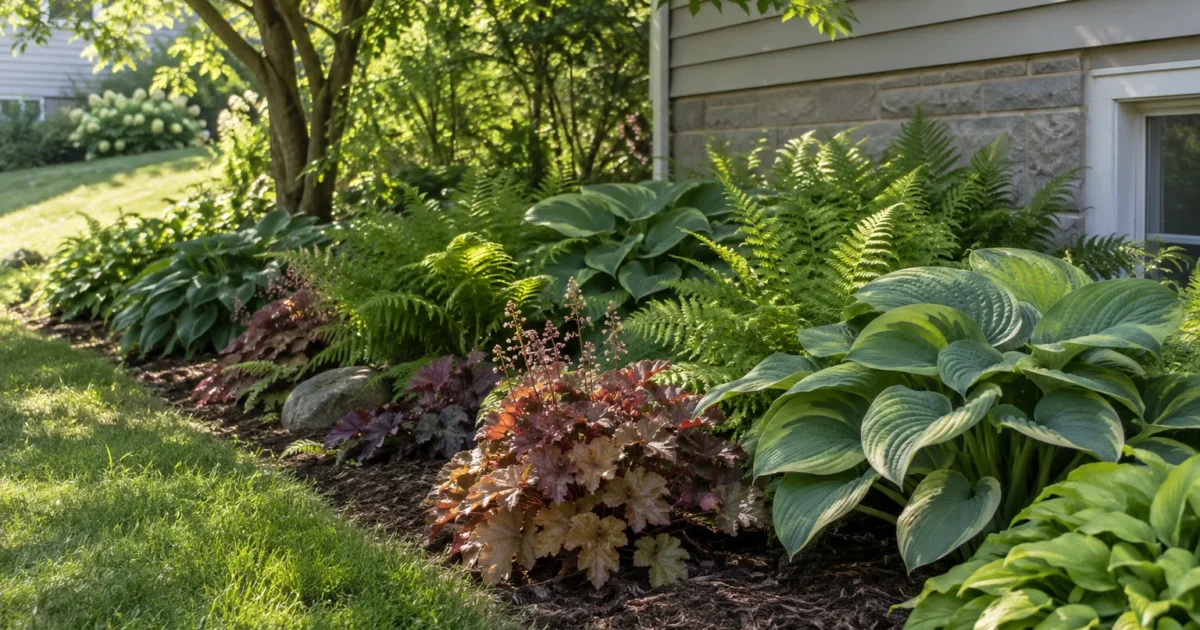
Coral bells (Heuchera) can work, but “sun or shade” is a cultivar-by-cultivar answer, not a species-wide rule. NC State’s Plant Toolbox notes that many Heuchera cultivars show their best leaf color in full sun and that hot, dry, full sun can scorch the foliage, while Heuchera villosa is better suited to partial shade or dappled light with heat and humidity tolerance (NC State Plant Toolbox: Heuchera, NC State Plant Toolbox: Heuchera villosa). Choose the specific cultivar for your light and climate rather than assuming “coral bells” is a single answer.
Smooth hydrangea needs neutral to acidic, well-drained soil and partial shade, and NC State notes it only tolerates full sun with consistent moisture — a fit for a part-shade north bed that doesn’t dry out (NC State Plant Toolbox: Smooth Hydrangea). Astilbe belongs in this category only if your bed stays reliably moist: NC State says Astilbe japonica requires partial to full shade and moist, rich, well-drained soil, and Missouri Botanical Garden separately warns its soil should never be allowed to dry out (NC State Plant Toolbox: Astilbe japonica, Missouri Botanical Garden). Skip it for a dry foundation strip.
Oakleaf hydrangea is a regional call. UF/IFAS places it in partial to almost full shade for Florida and says it needs at least some shade protection there, while cooler or moister regions may reasonably give it more sun — so treat this as “shade protection matters more the farther south and hotter your site is,” not one national light rule (UF/IFAS Gardening Solutions).
Plants for a Full-Shade (or Deep-Shade) North-Facing Bed
Under roughly 3 hours of light, your options narrow but don’t disappear — as long as you sort by moisture the way the section above sorted part-shade options.
Hosta is the classic full-shade recommendation, and it’s a reasonable one, but not an unconditional one. NC State’s Plant Toolbox describes hosta performing well in morning sun and dappled shade and prefers moist, organic, slightly acidic soil; in the South, it needs full or dappled shade specifically to prevent leaf burn, and it also needs a real winter dormancy period (a couple of months below 40°F) to perform well (NC State Plant Toolbox: Hosta). Read that as “hosta often thrives in shade or dappled, protected morning light where climate and moisture fit” — dense, dry, or warm-winter shade can still be a poor match.
For a dry, full-shade north bed, Pennsylvania sedge is a fit worth knowing: NC State lists it for dry-to-moist and heavy shade, with the caveat that it performs best in cooler climates (NC State Plant Toolbox: Pennsylvania Sedge). For a moist, full-shade north bed, UMN lists cinnamon fern for part to full shade with moist, organic soil, and royal fern for part to full shade with moist-to-wet soil (UMN Extension Raised Bed Gardens). Sort by moisture before you sort by name — a dry-shade plant in consistently wet soil, or a moisture-loving fern in dry shade, will struggle regardless of how well it matches the light rating.
In warm regions, cast iron plant is a strong option for genuinely deep shade: UF/IFAS says it performs in filtered and deep shade, should not be planted in full sun, and is hardy in USDA zones 7-11 — a warm-region answer, not a national default (UF/IFAS Gardening Solutions).
| Bed condition | Example plants | Key caveat | Source |
|---|---|---|---|
| Part shade, needs moisture | Smooth hydrangea, Astilbe | Astilbe must never dry out | NC State, Missouri Botanical Garden |
| Part shade, sun-tolerant cultivar | Heuchera (choose cultivar) | H. villosa wants more shade than sun-bred cultivars | NC State Plant Toolbox |
| Part shade, regional | Oakleaf hydrangea | Needs more shade protection in Florida/hot South | UF/IFAS |
| Full shade, dry soil | Pennsylvania sedge | Performs best in cooler climates | NC State Plant Toolbox |
| Full shade, moist soil | Cinnamon fern, royal fern | Needs consistently moist-to-wet soil | UMN Extension |
| Full shade, warm-winter region | Hosta (with caveats), cast iron plant | Hosta needs winter dormancy; cast iron is zones 7-11 only | NC State, UF/IFAS |
Some north-facing beds are too dark, too dry, or too tangled in tree roots for dense planting no matter what you choose. UF/IFAS treats dense building shadow, root-dominated ground, and very wet or very dry sites as genuinely difficult shade situations — where the better design answer is often mulch, a path, container plants, or hardscape rather than forcing a bed to support plants it can’t support (UF/IFAS EP457).
Mistakes That Sink a North-Facing Bed
The single biggest mistake, confirmed across every extension source behind this article, is treating “north-facing” as a guaranteed sun-hour number or an automatic “full shade” label. It isn’t either — it’s a starting clue that still requires you to measure (NC State Extension Gardener Handbook, UMN Extension).
The second is using your USDA hardiness zone as a stand-in for a light reading — it describes winter cold survival only, nothing about sun, moisture, heat, or drainage.
The third is forcing turfgrass into heavy shade. NC State says areas with less than 50 percent open sunlight or under 4 hours of sun are much too shady for turfgrass to grow well, and UMD says turf generally needs at least 6 hours of direct sun, with shade plus tree-root competition causing thinning (NC State Turfgrass in Shade, UMD Growing Grass in Shade). UMD does note that fine fescues can survive in shady, low-maintenance sites with as little as 2 hours of direct sun, though they don’t hold up to foot traffic — so “no turf in heavy shade” isn’t absolute, but it’s the safer default for anything but a marginal, low-traffic lawn.
The fourth is reaching for fertilizer when shade plants look leggy or sparse. UF/IFAS is direct that fertilizer is not a substitute for photosynthesis, and UGA adds that plants in the wrong light become weak and more vulnerable to pests and disease — thin growth in dense shade is a light problem first, not a feeding problem (UF/IFAS Ask IFAS EP457, UGA Extension).
The fifth is reaching for an old-school shade groundcover as a turf substitute without checking local status. UMD specifically advises against English ivy, periwinkle, Japanese spurge, bugleweed, and creeping lilyturf in Maryland landscapes because of invasive or aggressive spread, and the California Department of Fish and Wildlife separately lists English ivy as invasive statewide (UMD Groundcovers, CA Fish and Wildlife: English Ivy). Recommend the category — a low, spreading groundcover — and check your own region’s invasive list before you plant a specific species.
Can You Grow Vegetables in a North-Facing Bed?
A limited, real yes — as a chosen-to-grow crop, not a foraging or wild-plant question. UMN Extension supports lettuce, baby kale, scallions, microgreens, radishes, and beet greens in raised beds with part to full shade (UMN Extension Raised Bed Gardens). Keep your expectations to leafy harvests rather than fruiting crops, which generally need more direct sun than a north-facing bed provides.
Radishes are the one item on that list worth a caveat: Illinois Extension notes that too much shade can prevent the root from sizing up properly, even though the greens themselves stay edible (Illinois Extension: Radish). If your north bed runs on the shadier side, treat radish greens as the more reliable harvest and the root as a bonus, not a guarantee.
A note on safety: several common shade plants are toxic to pets. ASPCA lists hosta, hydrangea, and yew as toxic to dogs, cats, and horses, while coral bells (Heuchera) are listed as non-toxic to dogs, cats, and horses (ASPCA Toxic and Non-Toxic Plants). The ASPCA database also states its list isn’t all-inclusive, so treat any plant not named there as unknown rather than assumed safe. Pet Safe Plants: What the ASPCA Actually Lists walks through how to check a plant before it goes in a bed your animals can reach.
Find the Right Plants for Your Exact Bed
Everything above still leaves you with a range, not a single answer, because “north-facing” genuinely covers open shade, dense dry shade, and damp part shade depending on your yard. Once you’ve measured your bed’s real light and moisture, the Explore plant finder narrows that range to plants scored against the conditions you actually have — including a “North side” shade/cool spot filter built for exactly this situation — so you’re shopping from a shortlist instead of a guess.
Does a north-facing bed always mean full shade?
No. A north-facing bed misses direct overhead sun, but the actual light ranges from bright open shade next to a tall wall to dense shade under low tree branches. Measure the bed’s real hours of direct sun before assuming a light level.
How many hours of sun count as part shade?
Many extension guides use roughly 3 to 6 hours of direct sun as part sun or part shade, and less than about 3 hours as full shade, with 6-plus hours as full sun — though some regional guides use stricter thresholds, so treat these as common baselines, not universal cutoffs.
What grows well in a moist, shady north-facing bed?
Cinnamon fern and royal fern both fit part-to-full shade with consistently moist soil, and Astilbe can work if the bed never dries out. None of these tolerate a dry foundation strip.
What grows in a dry, shady north-facing bed?
Pennsylvania sedge fits dry-to-moist heavy shade and performs best in cooler climates. Avoid moisture-dependent choices like Astilbe or ferns in a bed that dries out between rains.
Can I grow vegetables in a north-facing bed?
Leafy crops like lettuce, baby kale, scallions, microgreens, and beet greens can work in part-to-full shade raised beds. Radishes are less reliable there — too much shade can limit root size even though the greens stay edible.
Are hostas and hydrangeas safe around pets?
No — the ASPCA lists both hosta and hydrangea as toxic to dogs, cats, and horses. Coral bells (Heuchera) are listed as non-toxic to all three. Check any plant you’re considering against the ASPCA database before it goes somewhere pets can reach.
Sources
- NC State Extension Gardener Handbook: Landscape Design
- UMN Extension: Gardening in the Shade
- UMN Extension: Raised Bed Gardens
- Michigan DNR: Sun Map
- USDA ARS: Plant Hardiness Zone Map
- Illinois Extension: Make a Garden Sun Chart
- Illinois Extension: Grow Successful Made-in-the-Shade Gardens
- Illinois Extension: Radish
- Penn State Extension: Evergreen Shrubs and Trees for Pennsylvania
- University of Maryland Extension: Landscape Designs with Native Plants
- University of Maryland Extension: Growing Grass in Shade
- University of Maryland Extension: Groundcovers
- UC ANR: Outstanding Plants for Alameda County
- UGA Extension: Landscape Design Part Two, Assessing Your Site
- UGA Extension: Care of Ornamental Plants in the Landscape
- NC State Extension: Visual Model of Shade in Your Yard
- NC State Extension: Selecting and Managing Lawn Grasses for Shade
- NC State Plant Toolbox: Hosta
- NC State Plant Toolbox: Smooth Hydrangea
- NC State Plant Toolbox: Astilbe japonica
- NC State Plant Toolbox: Heuchera
- NC State Plant Toolbox: Heuchera villosa
- NC State Plant Toolbox: Pennsylvania Sedge
- UF/IFAS Ask IFAS: Landscape Design for Shady Sites (EP457)
- UF/IFAS Gardening Solutions: Oakleaf Hydrangea
- UF/IFAS Gardening Solutions: Cast Iron Plant
- UNH Extension: How to Site a Greenhouse to Receive the Most Sun
- Missouri Botanical Garden: Astilbe Plant Finder
- California Department of Fish and Wildlife: English Ivy
- ASPCA: Toxic and Non-Toxic Plants
The bottom line
A north-facing bed is a starting clue, not a plant list. Measure your bed’s real hours of direct sun, check the soil for moisture after rain and during a dry spell, and rule out your USDA hardiness zone as a light indicator — it only tells you about winter cold. From there, sort candidates by shade level and moisture: Heuchera, smooth hydrangea, and oakleaf hydrangea for part shade; hosta, ferns, and Pennsylvania sedge for full shade, split by how wet or dry the soil runs; and cast iron plant for genuinely deep, warm-region shade. If the bed turns out too dark, dry, or root-filled for any of that, mulch, hardscape, or containers are the honest answer, not a struggling lawn. Once you know your bed’s real conditions, the Explore plant finder can match them to a shortlist instead of a guess.
More in this guide
- Plants for a Dry Sunny Slope: What Actually Survives There Plants for a Dry Sunny Slope: What Actually Survives There A hot, dry, south-facing slope is not solved by a generic “drought…
- Full Sun, Part Shade, or Full Shade: Read Your Yard Full Sun, Part Shade, or Full Shade: Read Your Yard Full sun means six or more hours of direct sunlight a day.…