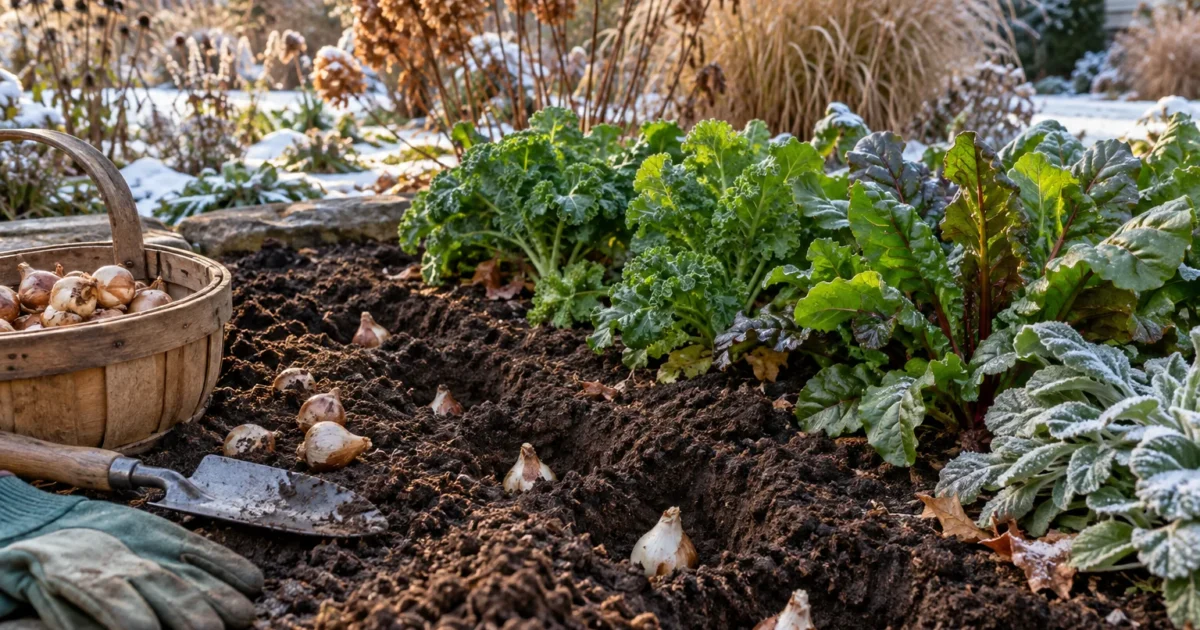
What to Plant in Fall (and What to Stop Planting Now)
Every autumn the garden center is still stacked with tomato starts, tulip bulbs, and flats of mums, and nothing on the shelf tells you which of them still has time. That’s the real question behind what to plant in fall: not “what grows in autumn,” but “which of these will make it before the cold arrives, and which will I lose?”
The honest answer is that it depends on the plant group, your winter hardiness zone, your local frost odds, and where you live. This guide gives you the decision rule for each, the plants that can still go in after many windows have closed, the ones to stop planting now, and the regional exceptions that make any single national deadline wrong.
The Quick Answer
- Can still go in (most places): hardy spring-flowering bulbs, garlic, cool-season vegetables that have enough days left before frost, and many trees and shrubs. Lawn seed and cover crops have narrower, species-specific windows.
- Stop planting now: warm-season vegetables such as tomatoes, peppers, cucumbers, and melons once their remaining days to harvest run past your likely frost.
- The catch: “now” is not the same date everywhere; it moves with your region and climate, as the regional section below shows. Check your own local probability, not a national calendar.
What to Plant in Fall Depends on Four Things, Not a Date
A fall planting calendar that lists one cutoff date for the whole country fails the same way every time. Four things decide what to plant in fall for your yard, and you need all four.
1. The plant group. A tomato, a tulip bulb, a garlic clove, a maple sapling, and a bag of lawn seed all have different deadlines. Sort what you’re holding into one of those groups first.
2. Your winter hardiness zone. USDA says its Plant Hardiness Zone Map is based on the average annual extreme minimum winter temperature, divided into 10°F zones and 5°F half-zones (USDA ARS). That tells you whether a perennial can survive your winters. It does not tell you when frost arrives, whether a transplant has time to root, or whether a vegetable can finish. USDA’s own guidance adds that a zone is a guide, and that microclimates, wind, moisture, snow cover, and winter sun all affect survival (USDA How to Use the Maps). If your zone changed recently, see why your USDA hardiness zone changed in 2023 and our USDA hardiness zone guide.
3. Local frost and freeze probability. Frost timing is a probability, not a date. NWS Boise, for example, publishes freeze probabilities based on observed temperatures from the 1991–2020 Climate Normals period, defining a freeze as temperatures at or below 32°F and a hard freeze as temperatures at or below 28°F (NWS Boise). The Midwestern Regional Climate Center offers a broader freeze-probability product for 32°F and 28°F (MRCC). Minnesota’s state climatology office notes that long-range forecasts of freeze dates are beyond current science, which is why historical probabilities are used for risk decisions (Minnesota DNR). For the spring version of this idea, see our last frost date guide.
4. Your region. More on that below. It changes the answer more than anything else.
Frost Is Not the Same as a Freeze
Here’s a detail that catches people out. A freeze is tied to 32°F, but frost can damage tender plants at air temperatures a little above that. NWS Boise says a frost can occur when temperatures reach or fall below 36°F (NWS Boise Freeze Data). Iowa State says warm-season vegetables can be damaged by frost below 36°F, not only by freezing temperatures (Iowa State Extension).
So don’t treat “first 32°F freeze” as the safe deadline for tomatoes, peppers, or annuals. For tender plants, check the frost probability as well; where a 36°F threshold is available, use it for conservative decisions. Otherwise treat the 32°F date as a risk marker, not a guarantee.
Two practical notes on alerts. According to NOAA, cold-weather hazard products were simplified effective October 1, 2024, consolidating hard freeze watches and warnings into Freeze Watch and Freeze Warning (NOAA). A 28°F “hard freeze” is still a useful plant-damage threshold, but you won’t see a separate hard-freeze alert to wait for. And NWS says a Frost Advisory means areas of frost are expected or occurring, posing a threat to sensitive vegetation, while a Freeze Watch signals the potential for significant, widespread freezing temperatures within the next 24 to 36 hours (NWS Cold Weather Alerts). Keep checking forecast lows.
What Can Still Go In
This is the “yes, plant it” half, and it’s longer than most people expect. Each group has its own rule.
| Group | Rule of thumb | Caveat |
|---|---|---|
| Fall vegetables (greens, radishes, spinach, and similar) | Count back from your first killing frost (see below) | Regional; many Upper Midwest windows close in summer |
| Hardy spring-flowering bulbs | Illinois Extension says they can generally be planted until the ground is frozen | Fall is the prime time; earlier gives roots more time |
| Garlic | Plant early enough for roots to form before the ground freezes, but not so early it makes excessive shoots (Penn State) | Timing varies by climate |
| Trees and shrubs | Aim for several weeks of root growth before freeze-up | Depends on species, stock type, and region |
| Cool-season lawn seed | Maryland’s guidance is mid-August to mid-October | Maryland-specific; check your state |
| Cover crops | Species and region decide the cutoff | Cereal rye can go in very late, with spring-only benefits |
Fall vegetables: count back from frost. OSU Extension’s method is to take the days from planting outdoors to harvest, add the days from seed to transplant if you’re using transplants, and add about two extra weeks because growth slows as days shorten and cool (OSU Extension). Subtract the total from your likely first killing frost and you have your last planting date for that crop. If you’d rather not do the math on every seed packet, Cornell Cooperative Extension publishes last seeding and transplanting dates for fall crops, worked out from an average first fall frost of October 1 at Ithaca, with the advice to shift them a week to ten days later in milder parts of New York and earlier in cooler ones (Cornell CCE).
Bulbs and garlic: later than you’d think. Illinois Extension says fall is the prime time for hardy spring-flowering bulbs, and that most can be planted until the ground is frozen (Illinois Extension). Earlier planting gives roots more time, but a late bulb in unfrozen soil still has a chance; one held in a bag until spring does not. Penn State’s garlic advice is a balance: roots should develop before the ground freezes, but not so early that shoots grow excessively (Penn State Extension).
Trees and shrubs: a conservative rule, not a hard stop. Illinois Extension says to plant perennials such as trees and spring- and summer-flowering shrubs about six weeks before first frost (Illinois Extension). Morton Arboretum says fall planting works for many trees and shrubs but warns that November-to-December planting raises the risk of poor root growth and plant failure (Morton Arboretum). Treat six weeks as a safe establishment target rather than a universal cutoff. Professional opinions vary on whether the deadline is first frost, ground freeze, or simply workable soil, and stock type matters: Oklahoma State says early fall is best for container-grown and balled-and-burlapped trees, while spring is best for bare-root plants and broadleaf evergreens such as holly and southern magnolia (Oklahoma State Extension). Ask your local extension office before planting late.
Lawn seed and cover crops. Maryland Extension puts cool-season turf seeding at mid-August to mid-October, and warns that seed outside the window can struggle with heat, frost, weeds, or too little daylight (Maryland Extension). For cereal rye as a cover crop, Penn State says the optimum seeding date is from September to late October, but that it can be planted as late as December or January in southern parts of Pennsylvania, in which case only spring benefits will be seen (Penn State Extension). Don’t assume one cutoff for all cover crops.
What to Stop Planting Now
The inverse of what to plant in fall is the expensive mistake: buying a plant after its window has already closed, then losing it to the first freeze.
Warm-season vegetables are the big one. University of Minnesota Extension classes tomatoes, peppers, eggplant, potatoes, winter squash, onions, green beans, cucumbers, and melons as not frost tolerant or extremely cold-sensitive in its crop-planning categories (UMN Extension). UF/IFAS says warm-season vegetables such as tomatoes and peppers are damaged or killed by frosts and freezes and don’t thrive when soil is too cool (UF/IFAS). The stop rule is simple: if the crop’s remaining days to harvest run past your likely frost, don’t plant it. A tomato start that can’t ripen before frost is money spent on a plant that can’t finish.
Direct-seeded fall vegetables, in cold-winter regions. In Minnesota-type climates, fall vegetable seeding is often a mid-summer job. According to the University of Minnesota’s Upper Midwest calendar, direct-seeded fall carrots, beets, and broccoli start in mid-July, and spinach and lettuce run through mid-August (UMN Extension). By mid-September in that region, a new seed row in an unprotected bed is usually too late. The same calendar places spring bulb planting from the second week of September through mid-November, which is the contrast worth remembering: vegetables can be over while bulbs are just starting.
The exception is protection. UF/IFAS notes that season extension can use protective covers, shade houses, high tunnels, and row covers, and UMN tracks spinach that overwinters in winter high tunnels. So “stop direct-seeding” applies to unprotected outdoor beds.
Where the Fall Planting Window Is Still Open
Any claim that fall planting is over nationally is wrong. Extension sources describe very different fall seasons:
- Florida. UF/IFAS says Florida gardeners can grow vegetables year-round if they follow region-specific planting dates, and it separates North, Central, and South Florida because frost and freeze risk differ.
- Low-desert Arizona. The University of Arizona’s Pima County guide says gardeners can direct-sow carrots, radishes, spinach, lettuces, turnips, green onions, beets, and chard by mid-September, and start broccoli, cabbage, cauliflower, and Brussels sprouts in trays to transplant the next month (University of Arizona Extension).
- Georgia and similar Southeast climates. UGA lists fall planting windows into October for radishes, leaf lettuce, beets, onions, broccoli, cabbage, and collards (UGA Extension).
- Maritime Pacific Northwest. OSU says many cool-season crops can produce in fall and hold through winter with protection, west of the Cascades.
- Upper Midwest. As above, many vegetable windows close in summer, while bulbs and some perennials are still in play.
The pattern: the colder your winters, the earlier vegetables stop and the more fall becomes a bulb, garlic, and woody-plant season. The milder your winters, the more fall becomes a second vegetable season.
How to Plant Trees and Shrubs So the Window Isn’t Wasted
If you’re using fall for trees and shrubs, the planting mistakes matter more than the date. Morton Arboretum says mistakes made during planting usually can’t be corrected afterward and can lead to the decline of the tree, and its planting guide comes down to a handful of points (Morton Arboretum):
- Don’t plant too deep; dig the hole only as deep as the roots or root ball.
- Leave the bottom of the planting hole undisturbed, so the tree has support underneath.
- Don’t mound mulch or let it rest against the trunk.
- Don’t fertilize at the time of planting.
- Water properly; both too much and too little moisture cause damage.
Other extension guides give similar instructions. Maryland Extension says not to loosen the soil underneath where the root ball will sit, because the plant can sink and leave the root flare too deep (Maryland Extension). Clemson says not to allow mulch to touch the stem or trunk, and that many plants die from too little or too much water in the first few months after planting (Clemson HGIC).
For bulbs, Illinois Extension recommends mixing bonemeal or superphosphate with the soil in the lower part of the planting bed as it is prepared (Illinois Extension).
A Pet Note on Fall Planting
Several classic fall plants are on the ASPCA’s toxic list. The ASPCA lists tulips, daffodils, chrysanthemums, and autumn crocus as toxic to dogs, cats, and horses (ASPCA Tulip, ASPCA Daffodil, ASPCA Chrysanthemum, ASPCA Autumn Crocus). For tulips and daffodils, the ASPCA notes the bulb is where the toxin is concentrated or the risk lies, which matters if a dog digs in fresh beds. Be careful with the word “crocus”: the ASPCA’s autumn crocus entry covers Colchicum autumnale, also called meadow saffron, and lists clinical signs of bloody vomiting, diarrhea, shock, multi-organ damage, and bone marrow suppression.
The ASPCA also says its list isn’t all-inclusive, so a plant that’s missing means unknown, not safe. This is not veterinary advice; see our pet-safe plants guide for how to read the list.
Find What Still Fits Your ZIP
Cooperative extension services publish strong state-level planting calendars, and for the “what to plant” half of this question they often beat any national guide. Use them. Where we can help is the last step: matching plants to your real conditions and flagging what’s closed.
Enter your ZIP in the Explore plant finder to filter plants by your current USDA zone, then check each candidate’s planting window against your local frost probability and extension calendar. For perennial picks in a cold zone, see perennials for zone 4. One limit: the USDA zone covers winter cold only, so it won’t tell you about frost timing, heat, or rainfall, and microclimates in your own yard can run warmer or colder than the map.
What can I still plant in fall after the first frost?
Hardy spring-flowering bulbs can generally be planted until the ground freezes, according to Illinois Extension. Garlic, per Penn State Extension, should go in early enough for roots to develop before the ground freezes. Warm-season vegetables can’t, since frost damages or kills them.
Is 32°F the safe cutoff for planting tomatoes and peppers?
No. A freeze is tied to 32°F, but frost can damage tender plants a little above that. Iowa State says warm-season vegetables can be damaged below 36°F, so use the frost probability where you can find it.
How do I know when to stop planting fall vegetables?
OSU Extension’s method: add the days from planting to harvest, the days to grow transplants if you use them, and about two extra weeks, then count back from your first killing frost. Cornell’s last-planting-date table is an easier fallback.
Is it too late to plant trees and shrubs in fall?
Not necessarily. Illinois Extension suggests about six weeks before first frost as a conservative target, but Morton Arboretum says November-to-December planting raises the risk of failure, and stock type and region matter. Ask your local extension office.
Does my USDA hardiness zone tell me when to plant in fall?
No. USDA’s zone map is based on average annual extreme minimum winter temperature only. It tells you which perennials can survive winters, not when frost arrives or whether a plant has time to establish.
Are fall bulbs safe around pets?
Not always. The ASPCA lists tulips, daffodils, chrysanthemums, and autumn crocus as toxic to dogs, cats, and horses. The ASPCA also says its plant list is not meant to be all-inclusive. Our own advice: don’t assume an unlisted plant is safe.
Sources
- USDA ARS: Plant Hardiness Zone Map
- USDA ARS: How to Use the Maps
- NWS Boise: Freeze Probabilities
- NWS Boise: Freeze Data
- MRCC: Freeze Probabilities
- Minnesota DNR: Freeze Dates
- NWS: Cold Weather Alerts
- NOAA: Cold Hazard Simplification
- Iowa State Extension: Cold and Freeze Damage to Garden Plants
- OSU Extension: Growing Your Own
- Cornell CCE: Last Planting Dates
- Illinois Extension: Planting Bulbs
- Illinois Extension: Establishing Perennials in Early Fall
- Penn State Extension: Garlic Production
- Penn State Extension: Cereal Rye as a Cover Crop
- Morton Arboretum: Fall Planting Trees and Shrubs
- Morton Arboretum: How to Plant Trees and Shrubs
- Maryland Extension: Planting a Tree or Shrub
- Maryland Extension: Starting a New Lawn
- Clemson HGIC: Planting Trees Correctly
- Oklahoma State Extension: Planting Trees and Shrubs
- UMN Extension: Vegetable Crop Planning Tools
- UMN Extension: Upper Midwest Home Garden Care Calendar
- UF/IFAS: Florida Vegetable Gardening Guide
- University of Arizona Extension: September Gardening Guide, Pima County
- UGA Extension: Fall Vegetable Gardening
- ASPCA: Toxic and Non-Toxic Plants
- ASPCA: Tulip
- ASPCA: Daffodil
- ASPCA: Chrysanthemum
- ASPCA: Autumn Crocus
Educational content only. Not a substitute for licensed professional or extension-office advice. Local climate, frost timing, and site conditions vary by yard and region. Use of any guidance from this guide is at your own risk.
Get the homeowner’s plant-shopping starter checklist — the questions to answer about your site before you buy anything. [Free download — enter your email]
More in this guide
- Perennials for Zone 4: What Actually Comes Back in a Cold Zone Perennials for Zone 4: What Actually Comes Back in a Cold Zone Search for perennials for zone 4 and you’ll get long…
- Why Your USDA Hardiness Zone Changed in 2023 Why Your USDA Hardiness Zone Changed in 2023 If you looked up your zone recently and got a different answer than you…
- Last Frost Date: How to Use It (and What It Can’t Tell You) Last Frost Date: How to Use It (and What It Can’t Tell You) If you’ve ever typed your ZIP code into a…
- USDA Plant Hardiness Zone: Find Yours & What It Means USDA Plant Hardiness Zone: Find Yours & What It Means Your USDA plant hardiness zone is a single number that tells you…
Related guides
Perennials for Zone 4: What Actually Comes Back in a Cold Zone
Perennials for Zone 4: What Actually Comes Back in a Cold Zone Search for perennials for zone 4…
Why Your USDA Hardiness Zone Changed in 2023
Why Your USDA Hardiness Zone Changed in 2023 If you looked up your zone recently and got a…
Last Frost Date: How to Use It (and What It Can’t Tell You)
Last Frost Date: How to Use It (and What It Can’t Tell You) If you’ve ever typed your…