Perennials for Zone 4: What Actually Comes Back in a Cold Zone
Search for perennials for zone 4 and you’ll get long lists of plants that all claim to survive your winter. Most of them can, on paper. The catch is what “on paper” means: a zone rating tells you a plant’s published cold tolerance reaches zone 4 or colder, and nothing about whether it will return in your particular yard. USDA is direct about this — the map is a general guide, not a prediction of the lowest temperature that has occurred or will occur at a site.
This guide covers what a zone 4 rating really promises, seven perennials commonly listed as hardy into zone 4 or colder (each with the caveat that goes with it), how winter mulch fits in, and the regional and site limits that no zone number can see.
Perennials for Zone 4 Start With What the Zone Actually Measures
The USDA Plant Hardiness Zone Map is based on the average annual extreme minimum winter temperature, displayed as 10-degree zones and 5-degree half-zones, according to USDA’s guidance on using the maps. That’s a winter-cold screen. It says nothing about sun, soil, drainage, or summer heat — and a plant rated for your zone can still fail on any of them.
So when a plant is described as one of the perennials for zone 4, read it as: “the published hardiness range includes zone 4 or a colder zone.” Not: “this will come back in every zone 4 yard.” University of Minnesota Extension makes the same point from the plant side — hardiness zone alone doesn’t guarantee performance, because planting, soil type, light, space, wind, and care all matter. NC State says the USDA zone and light are only a few pieces of the plant-selection puzzle, and that the map doesn’t account for summer temperatures.
Two more details are worth knowing. Zone 4a and 4b are both “zone 4” but don’t represent the same temperature band, so a bed near a boundary deserves a closer look. And if the 2023 update moved your mapped zone, USDA says you don’t need to remove plants or change what you grow — plants already thriving in your yard will likely continue to. (More on that in why your USDA hardiness zone changed in 2023, and the basics in our USDA plant hardiness zone guide.)
Seven Perennials Commonly Listed as Hardy Into Zone 4 or Colder
These are examples, not guarantees. Each is supported by university, extension, or botanical-garden sources as zone 4-compatible or colder, and each comes with a caveat worth reading before you buy.
| Plant | Published range | What to know |
|---|---|---|
| Purple coneflower (Echinacea purpurea) | Zones 3a-8b (NC State); zones 3-8 (Illinois Extension) | Full sun and well-drained soil |
| Hosta | Zones 3a-9b (NC State) | Cultivars vary; performs well in morning sun and dappled shade, and blue-leaved forms are reported to need deep shade |
| Daylily (Hemerocallis) | Zones 3a-9b (NC State); zones 3-9 for examples at Missouri Botanical Garden | Dormant and evergreen types behave differently in cold winters |
| Herbaceous peony | Zones 3a-8b (NC State); generally zones 3-8 (Wisconsin Horticulture) | Herbaceous, tree, and Itoh peonies are different; specify the type |
| Yarrow (Achillea millefolium) | Zones 4-8 (Clemson HGIC) | Can be short-lived in wet sites; may melt out in hotter zones 7b-9 |
| Blue false indigo (Baptisia australis) | Zones 3-9 (Missouri Botanical Garden) | Deep roots; shouldn’t be disturbed once established |
| Wild bergamot (Monarda fistulosa) | Zones 3-9 (Ohio State) | Full sun to part shade, dry-to-medium water |
A few of those caveats deserve a sentence of their own. Peonies may fail to bloom if planted too deep, overfertilized, planted in too much shade, or moved recently, according to the extension sources behind this guide. Yarrow may flop in rich or moist soils and spread aggressively. Monarda hybrids can differ in mildew resistance, and crowding a planting reduces airflow — so spacing helps. Baptisia is the plant to site carefully the first time, since established plants resent being moved.
Notice the phrasing above: “hosta cultivars vary,” “herbaceous peony,” “daylily type matters.” A genus-wide zone range is the outer edge of the family, not a promise for the specific plant in your cart. Check the tag or nursery listing for the cultivar and type, and if a plant matters to you, look at more than one source.
What a Zone 4 Rating Can’t See
Winter cold is one gate. The plant still has to get through the rest of the year, and the rest of your particular site.
Summer heat, rain, and drainage. NC State’s guidance on native plants explicitly discusses summer temperatures, rainfall intensity, drainage, reflected heat, salt, compacted urban soils, and site exposure as factors that can defeat a plant even when it’s winter-hardy. A hardiness number was never built to capture any of that.
Microclimates. USDA notes that individual gardens can have localized microclimates, including sheltered warm spots and low cold-air pockets, and that the map’s resolution can’t show features that small. A south-facing wall, an exposed wind corridor, or a low frost pocket can change how the same plant does.
Snow cover and freeze-thaw. UMN Extension calls snow the best winter protection for perennials — but adds that adequate snowfall can’t always be relied on. A bare freeze is harder on a plant than the same temperature under a blanket of snow. Alternating freezing and thawing can also heave plants out of the soil and destroy roots, which is how a technically hardy perennial fails after a winter that never looked especially cold.
Containers and raised planters. UMN explains that roots are generally less hardy than stems, and that they survive winter partly because soil temperatures are normally warmer and change more slowly than air temperatures. An in-ground zone rating shouldn’t be casually transferred to an exposed pot. Container overwintering needs its own guidance.
Sun and soil. Zone says nothing here either. If you’re also weighing light, our full sun vs. part shade guide covers the second half of the question. One drainage caution: don’t fix a clay bed by mixing in sand. Illinois Extension says sand in clay usually doesn’t solve drainage and can create a hard, concrete-like structure unless used at impractically high ratios. Follow local extension guidance, or choose plants suited to the site you have.
Winter Care: Mulch Is Situational, Not Automatic
Extension sources agree on timing but not on scope, and it’s worth being honest about that rather than giving one rigid rule.
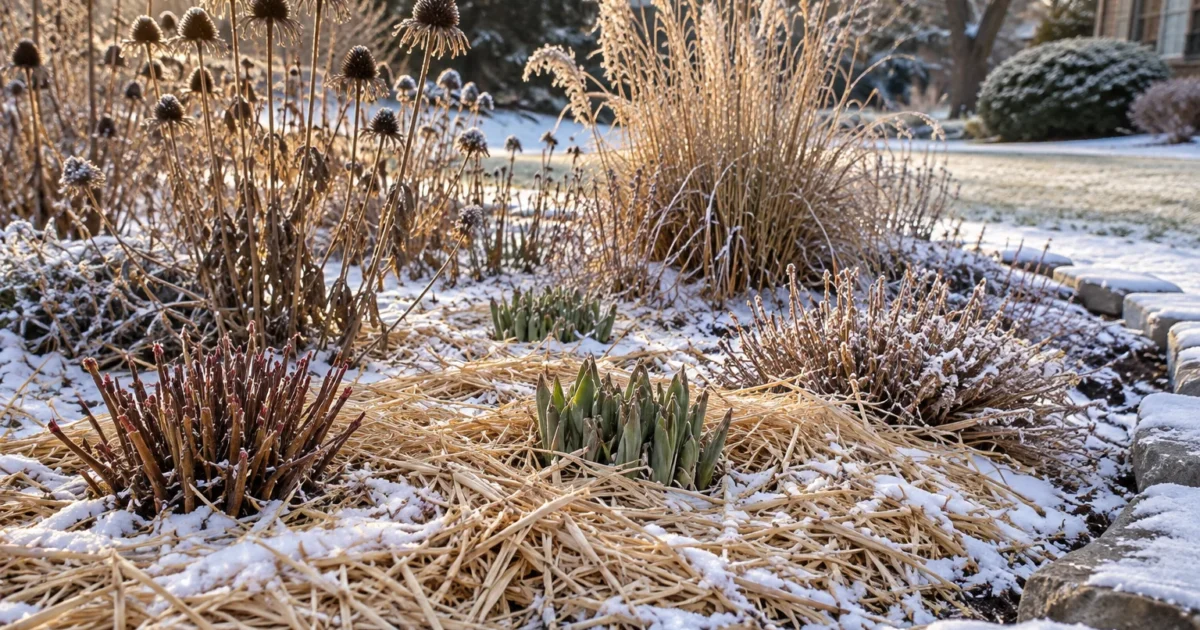
Timing. UMN says protective mulch should go on as the soil begins to freeze, or after that point. Other extension sources line up with that. Iowa State’s perennial bed guidance says to apply extra mulch after the ground freezes. Penn State’s perennial care page says to apply winter mulch when the ground is frozen. Illinois Extension’s planting and care page says to apply it after the soil is frozen. Wisconsin Horticulture’s winter preparation article says soils would ideally have just started to freeze. Mulching heavily during early fall cleanup is the mistake to avoid.
Who needs it. According to Penn State Extension, winter mulch is mainly for newly planted, recently divided, or tender perennials, applied when the ground is frozen and removed gradually in spring. Illinois Extension similarly says most established perennials don’t need extra winter mulch if the soil is well prepared and drainage is good, while late-planted or transplanted perennials may benefit from a loose layer after the soil freezes. So the honest answer for established plants in well-drained beds is often “probably not,” and for new, divided, late-planted, or exposed plants, “probably yes.”
Materials. Wisconsin Horticulture suggests waiting until plants are dormant and the soil has just started to freeze, then using straw, marsh hay, or evergreen boughs — leaves may mat down and smother plants.
Fall cleanup. Iowa State says cutting back after a hard freeze is optional for many perennials. Healthy stems and seed heads can stay for winter interest and wildlife; diseased or insect-damaged material should go; aggressive seeders may benefit from late-season deadheading. Common DIY practice is to cut everything down, but extension guidance is more selective, so professional opinions vary by plant and site.
Spring removal. Pull excess mulch back as it thaws. UMN’s perennial mulch guidance notes that leaving winter mulch too long can increase crown rot and fungal problems.
Regional Caveats for Zone 4 and Colder
“Zone 4” isn’t one climate. The same number covers very different places, so the regional caveat matters as much as the range.
Northern Midwest. UMN supports a northern-garden framing — perennial flowers can survive Minnesota winters and live more than one year — but that shouldn’t be stretched to every cold region.
Interior West and mountain gardens. Colorado State Extension’s herbaceous perennial list is explicitly best adapted to Colorado’s lower elevations, though some listed perennials may do well higher up. Mountain exposure, elevation, wind, water, and soil can still change the outcome, so don’t generalize a lower-elevation list to a high-elevation garden.
Southeast. Winter-hardy doesn’t mean regionally adapted. NC State points to summer heat, heavy rain, drainage, reflected heat, and compacted soils as reasons a cold-hardy plant can struggle. (One of NC State’s sources, a woody ornamentals handbook, also notes that warm nights in the South can stress plants by increasing respiration and depleting food reserves. That source is about woody plants, so treat it as general background rather than proof for every herbaceous perennial.)
A Note on Pets
If you have dogs, cats, or horses, some of the plants above need a second look. The ASPCA lists hosta as toxic to dogs, cats, and horses; daylilies as toxic to cats and non-toxic to dogs; and peony as toxic to dogs, cats, and horses. The ASPCA also says its plant list is not all-inclusive — so a plant missing from it isn’t confirmed safe, it’s simply unknown. This guide doesn’t cover children, and it isn’t veterinary or medical advice. For a fuller look, see our pet-safe plants guide.
Find Which Perennials for Zone 4 Fit Your Yard
Here’s the practical handoff. Instead of scrolling a generic list, enter your ZIP in the Explore plant finder. The finder is our own tool, not USDA’s: it looks up your ZIP’s zone on the 2023 USDA Plant Hardiness Zone Map, and then our site applies its own cold-hardiness filter to our plant list, so you start from a shortlist built around your real zone.
Then do the part no tool can do for you: look at the actual bed. Check the sun, the drainage, the wind, and the low spots. A mapped zone tells you what the winter does on average across a ZIP code; your yard has the final say. If you’re planning spring planting, our last frost date guide covers the timing side.
What are perennials for zone 4?
They’re perennials whose published hardiness range includes zone 4 or a colder zone. Examples commonly listed that way include purple coneflower, hosta, daylily, herbaceous peony, yarrow, blue false indigo, and wild bergamot.
Will a zone 4 perennial definitely come back in my zone 4 yard?
Not definitely. USDA describes the map as a general guide based on average annual extreme minimum winter temperature. Sun, soil, drainage, wind, snow cover, and freeze-thaw cycles can all change the outcome.
Do I need to mulch perennials for winter?
It depends. According to Penn State Extension, winter mulch is mainly for newly planted, recently divided, or tender perennials. Illinois Extension says most established perennials in well-prepared, well-drained soil don’t need extra winter mulch.
When should I put winter mulch on perennials?
UMN Extension says as the soil begins to freeze or after. Waiting for cold soil, rather than mulching during early fall cleanup, is the common thread across extension sources.
Does a zone 4 rating work for plants in pots?
Not reliably. UMN notes roots are generally less hardy than stems and that in-ground soil temperatures change more slowly than air temperatures, so an exposed container needs separate overwintering guidance.
Are hostas, daylilies, and peonies safe around pets?
The ASPCA lists hosta and peony as toxic to dogs, cats, and horses, and daylilies as toxic to cats and non-toxic to dogs. A plant that isn’t on the ASPCA list is unknown, not safe.
Sources
- USDA Plant Hardiness Zone Map: How to Use the Maps
- USDA ARS: 2023 Plant Hardiness Zone Map announcement
- UMN Extension: Mulch perennials and bulbs after the soil freezes
- UMN Extension: A new plant hardiness zone map from the USDA
- UMN Extension: Flowers
- UMN Extension: Protecting trees and shrubs in winter
- NC State Extension: Design tips for working with native plants
- NC State Extension: Extension Gardener Handbook, woody ornamentals
- Iowa State Extension: Preparing perennial beds for winter
- Penn State Extension: Care and maintenance of perennials
- Illinois Extension: Planting and care
- Illinois Extension: Does sand improve clay soil drainage?
- Wisconsin Horticulture: Preparing landscape plants for winter
- Colorado State Extension: Herbaceous perennials
- Missouri Botanical Garden: Baptisia australis
- ASPCA: Toxic and non-toxic plants
Educational content only. Not a substitute for licensed professional or extension-office advice. Local climate and microclimates vary by yard and by year. Use of any guidance from this guide is at your own risk.
Get the homeowner’s plant-shopping starter checklist — the questions to answer about your site before you buy anything. [Free download — enter your email]
The Bottom Line
Zone 4 is a winter-cold filter, not a promise. Use it to narrow the field, then let your actual bed — its sun, drainage, wind, and snow cover — make the final call. Choose the specific type and cultivar rather than trusting a genus-wide range, mulch only where the plant and site call for it, and wait for the soil to freeze first.
More in this guide
- Why Your USDA Hardiness Zone Changed in 2023 Why Your USDA Hardiness Zone Changed in 2023 If you looked up your zone recently and got a different answer than you…
- Last Frost Date: How to Use It (and What It Can’t Tell You) Last Frost Date: How to Use It (and What It Can’t Tell You) If you’ve ever typed your ZIP code into a…
- What to Plant in Fall (and What to Stop Planting Now) What to Plant in Fall (and What to Stop Planting Now) Every autumn the garden center is still stacked with tomato starts,…
- USDA Plant Hardiness Zone: Find Yours & What It Means USDA Plant Hardiness Zone: Find Yours & What It Means Your USDA plant hardiness zone is a single number that tells you…
Related guides
Why Your USDA Hardiness Zone Changed in 2023
Why Your USDA Hardiness Zone Changed in 2023 If you looked up your zone recently and got a…
Last Frost Date: How to Use It (and What It Can’t Tell You)
Last Frost Date: How to Use It (and What It Can’t Tell You) If you’ve ever typed your…
What to Plant in Fall (and What to Stop Planting Now)
What to Plant in Fall (and What to Stop Planting Now) Every autumn the garden center is still…