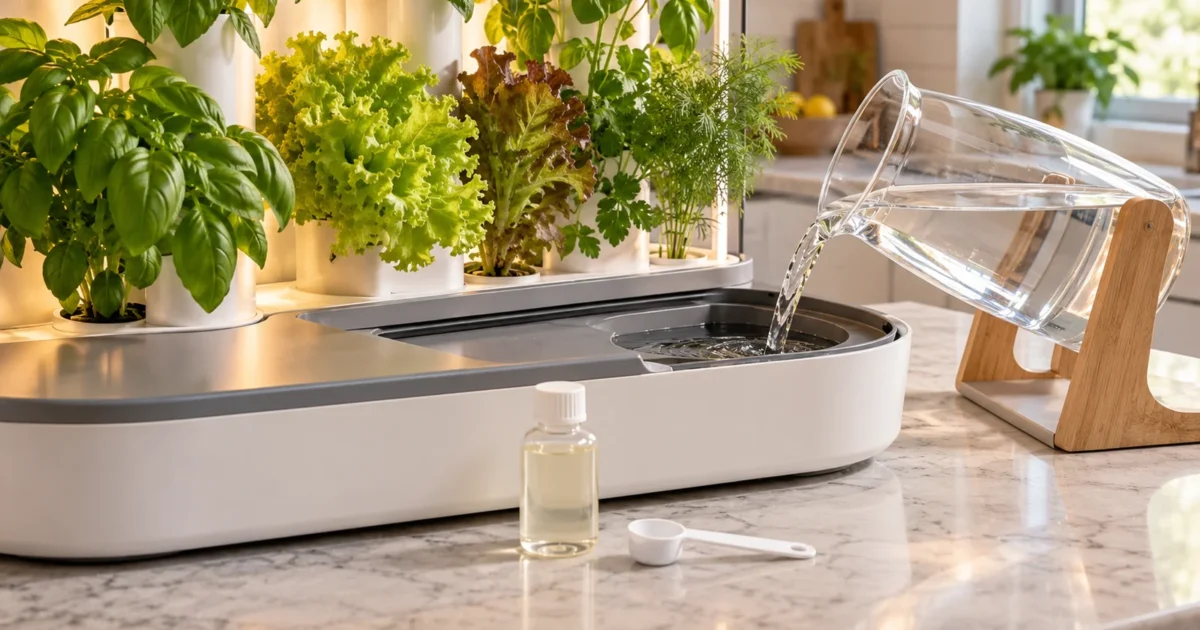
Gardyn HydroBoost: What It Does, Whether You Need It, and What to Use Instead
You own a Gardyn, and every time you order plant food, Gardyn HydroBoost sits next to it at $49.99 a bottle. It is easy to wonder whether it is a necessary part of keeping the garden alive, or an add-on that only some owners need. The honest answer is that Gardyn’s own documents say both things, in different places.
This page covers what HydroBoost is, what Gardyn claims for it, what its own maintenance guides say about skipping it, what a month of it costs, and what peroxide, a hydroponic pH-down and a citric-acid cleanse can and cannot take over. Performance benefits below are Gardyn’s claims. We found no independent test that proves them.
The Short Answer
- What it is: a water treatment, not a fertilizer. Gardyn says it cannot replace plant food (Gardyn first-feeding guide).
- Do you need it? Gardyn publishes top-off and tank-refresh workflows in which HydroBoost is optional (Gardyn top-offs). Its water-quality article also calls weekly HydroBoost and monthly refreshes essential for pH and EC management (Gardyn water quality). Both wordings exist, so there is no blanket answer.
- What it costs: about $2.60 to $17.33 a month at Gardyn’s weekly doses, by our arithmetic from the $49.99 bottle price. More if you treat as often as the manufacturer allows.
- What it does not replace: tank refreshes, root maintenance and plant food.
- The peroxide catch: Gardyn’s help center gives a peroxide dose (Gardyn peroxide article), while the Home 4 manual mentions peroxide among chemicals it does not authorize (Home 4 Grow Guide). We could not find anything that settles it.
Gardyn HydroBoost: What It Is and What Gardyn Says It Does
HydroBoost comes in a 250 mL bottle. Gardyn’s product page lists three ingredients: citric acid, triterpenic saponins and limonene (Gardyn HydroBoost). We could not verify concentrations, a complete back label, or a public safety data sheet that gives the formula. That is a gap in what we found, not a claim that Gardyn has no such sheet.
Gardyn markets the product for lowering and stabilizing pH, supporting nutrient balance and reducing cleaning. Its help documentation credits the treatment with preventing or reducing algae, biofilm and nutrient or salt deposits (HydroBoost use guide). Those are Gardyn’s claims. We found no comparative experiment showing HydroBoost beats peroxide or any other approach.
According to Gardyn’s guide, you should keep it away from stainless steel, not drink it, and rinse after skin contact (HydroBoost use guide).
Gardyn’s published dose
Gardyn’s table is per full tank, usually weekly once plant food is in the water (HydroBoost use guide). We keep its milliliters because the teaspoon equivalents are rounded (HydroBoost use guide).
| Gardyn water category | Home | Studio |
|---|---|---|
| Standard | 2 tsp / 10 mL | 1.5 tsp / 8 mL |
| Hard | 4 tsp / 20 mL | 3 tsp / 16 mL |
| Filtered, RO, distilled or naturally soft | 1 tsp / 5 mL | 0.5 tsp / 3 mL |
Gardyn permits treatment as often as every three days for high-demand fruiting gardens (Gardyn water quality). That is an allowed scenario, not a requirement for every mature planting. The same guide says a Home-level dose will not hurt plants or the device in a Studio, and that it gives a dose for each device for an optimized growing experience (HydroBoost use guide). By our arithmetic from the guide’s dose table, the larger Home amount empties a bottle sooner (HydroBoost use guide).
HydroBoost Is Not Plant Food
Plant food supplies nutrients and HydroBoost treats the water. Buying one does not remove the need for the other. University of Georgia hydroponics guidance describes nutrient delivery as dissolved fertilizer in the water (University of Georgia: Hydroponic Gardening for the Homeowner and Small Grower).
For topping off, Gardyn tells owners to dissolve plant food in the added water before pouring it into the tank, and lists HydroBoost as optional (Gardyn top-offs). According to Gardyn, plant food is 7-3-11 NPK (Gardyn plant food).
When to start
Here Gardyn’s own pages disagree. The product page and the HydroBoost help article both contain day-one language, while the help article and the first-feeding guide also say to add HydroBoost once plant food is in the tank (HydroBoost use guide, Gardyn first-feeding guide). We do not treat either “day one is required” or “day one is harmful” as settled. What we can say is that Gardyn’s first-feeding steps put HydroBoost after plant food, and Gardyn’s peroxide article places it after leaving Germination Mode (Gardyn peroxide article). If you are starting fresh sprouts, follow that staged sequence.
Do You Need It? What Gardyn’s Own Guidance Says
Gardyn labels HydroBoost optional in its top-off and tank-refresh instructions (Gardyn top-offs, Gardyn tank refresh guide). That supports one precise statement: Gardyn’s top-off and tank-refresh steps call for water and plant food and list HydroBoost as optional (Gardyn top-offs, Gardyn tank refresh guide). It does not prove identical results for every owner. Gardyn’s water-quality article, by contrast, calls weekly HydroBoost and monthly refreshes essential for pH and EC management (Gardyn water quality). So we would not say Gardyn consistently calls it unnecessary.
What HydroBoost does not change is the refresh. Gardyn’s tank refresh guide sets the baseline at least every four weeks, sooner if you notice yellowing leaves, leaf-edge burn or yellowing between leaf veins (Gardyn tank refresh guide). Its water-quality article suggests refreshing as often as every 14 days with four or more fruiting plants such as tomatoes, peppers or cucumbers (Gardyn water quality). A refresh means draining, cleaning the reservoir and refilling with fresh water and stage-appropriate plant food (Gardyn tank refresh guide).
| Task | With HydroBoost | Without HydroBoost |
|---|---|---|
| Tank refresh | At least every four weeks | Same published baseline |
| Whole-device cleanse | Gardyn’s peroxide article says HydroBoost, with regular tank refreshes and root maintenance, can replace it (Gardyn peroxide article) | No separate fixed interval turned up in our research |
| Root inspection and maintenance | Continue | Continue |
The whole-device cleanse, which Gardyn calls a total Gardyn cleanse, is the job Gardyn ties to HydroBoost (Gardyn peroxide article). It says regular use alongside refreshes and root maintenance reduces or may eliminate it, and its peroxide article says that combination can replace weekly peroxide and the total cleanse (Gardyn cleaning prevention, Gardyn peroxide article). That is conditional manufacturer guidance. It is not a promise that visible buildup can be ignored.
Wider hydroponic schedules differ. Oklahoma State recommends daily pH and EC checks and solution replacement every two weeks, while Georgia recommends complete changes every three to four weeks (OSU: Electrical Conductivity and pH Guide for Hydroponics, University of Georgia). Use Gardyn’s schedule for a Gardyn, and expect professional opinions to vary.
What to Use Instead: What Each Alternative Replaces
None of these is a like-for-like substitute. They do different jobs, and we found no source that tests any of them against HydroBoost in a Gardyn.
| Alternative | What it does | What it does not establish |
|---|---|---|
| 3% hydrogen peroxide | Antimicrobial treatment. Gardyn’s help article gives 1 tbsp per gallon of top-off water or 5 tbsp at a full-tank refresh (Gardyn peroxide article) | pH stabilization; harmlessness; Gardyn’s authorization on every model |
| Hydroponic pH-down | Lowers nutrient-solution pH, per General Hydroponics for its pH Down (General Hydroponics: pH Down) | Algae or biofilm control; Gardyn compatibility; a universal dose |
| Citric-acid cleanse | A reset cleaning with plants removed | A planted-tank dose or weekly substitute |
| Vinegar | Cleaning column exteriors and soaking removed parts | A documented circulating dose |
Peroxide
Gardyn’s help article specifies only 3% peroxide, one tablespoon per gallon of top-off water or five tablespoons at a full-tank refresh (Gardyn peroxide article). It does not separate Home from Studio in that refresh instruction, so we do not rescale it (Gardyn peroxide article). The Home 4 manual, however, mentions peroxide among untested or unauthorized chemicals and ties prohibited use to warranty consequences (Home 4 Grow Guide). Do not treat peroxide as unconditionally authorized or warranty-safe, and ask Gardyn about your model first.
The research is not a free pass either. A 2021 lettuce study found responses depended on fertilizer and concentration, including adverse effects under mineral-fertilizer conditions, and reported early plant death at 75 mg/L under its experimental conditions (Lau and Mattson, 2021). A 2022 lettuce and basil study found no significant overall algae control across the treatments it tested (Hendrickson et al., 2022). A 2024 commercial-hydroponics study found peroxide less effective than sodium hypochlorite under its tested surface-biofilm conditions (Tham et al., 2024). None tested a Gardyn, and none shows injury at Gardyn’s published dose.
A hydroponic pH-down
General Hydroponics describes its ordinary liquid pH Down as a phosphoric-acid formulation. Its instructions say to add nutrients first, then small acid additions, mixing and testing between them (General Hydroponics: pH Down). A good pH reading also cannot tell you the nutrient concentration is right. Treat pH-down as acidification only.
Hydroponic Research markets PHLO for pH reduction plus water conditioning and cleaning (Hydroponic Research: PHLO). No manufacturer source we reviewed says it matches HydroBoost’s formula or is a one-for-one swap, so it is an unverified candidate, not a recommendation.
Citric acid and vinegar
For a reset between grows, Gardyn’s circulating-cleanse procedure uses one cup of citric acid dissolved in two cups of water for Home, added to at least three gallons in the tank (Gardyn whole-device cleanse). Studio uses three-quarters of a cup in two cups of water, added to at least two gallons (Gardyn whole-device cleanse). Follow the full brushing, circulating, draining and flushing steps (Gardyn whole-device cleanse). Those are cleaning concentrations, not planted-reservoir doses.
Gardyn permits equal parts plain vinegar and water for column exteriors and removed-part soaking, but its irrigation flush refers back to the citric-acid procedure (Gardyn Starting Fresh). Routine refreshes call for water, a soft sponge and baking soda. The whole-device procedure does wash the tank with dish soap (Gardyn whole-device cleanse), so “Gardyn says never use soap” would be wrong. Also keep “cleaning” separate from “sterilizing”: University of Minnesota guidance distinguishes debris removal from sanitation, and a household-acid soak does not establish a kill rate (University of Minnesota Extension: Small-scale hydroponics).
What It Costs per Month, Side by Side
HydroBoost is $49.99 per 250 mL bottle. Gardyn lists subscriptions at $44.99 for nonmembers and $39.99 for members, with membership fees separate (Gardyn HydroBoost, Gardyn Subscribe & Save). The table uses the full $49.99 and Gardyn’s weekly doses, so it is our arithmetic, not a promised shelf life.
| Model and water | Weekly mL | Bottle lasts (weeks) | Monthly cost |
|---|---|---|---|
| Home, standard | 10 | 25 | $8.67 |
| Studio, standard | 8 | 31.25 | $6.93 |
| Home, hard | 20 | 12.5 | $17.33 |
| Studio, hard | 16 | 15.6 | $13.86 |
| Home, soft or RO category | 5 | 50 | $4.33 |
| Studio, soft or RO category | 3 | 83.3 | $2.60 |
Gardyn’s pages advertise a bottle lasting about six months, but dose-based arithmetic is the better guide: at the hard-water Home dose a bottle lasts about three months. Gardyn’s use guide allows HydroBoost up to every three days in Gardyns with large, mature plants that need more frequent top-offs (HydroBoost use guide), and its water-quality article allows the same with four or more fruiting plants (Gardyn water quality). By our arithmetic, treating every three days gives about 75 days per bottle (roughly $20.27 a month) at the Home standard dose and 37.5 days (roughly $40.55) at the hard-water dose.
Prices below are displayed retail prices we recorded on October 14, 2026, before tax and delivery. They compare spend, not equivalent treatment.
| Product | Listed price | What that works out to |
|---|---|---|
| Equate 3% peroxide (Walmart) | $1.00 / 32 fl oz | About $0.0156 per tablespoon |
| General Hydroponics pH Down, quart (Garden Dominion) | $8.89 | About $0.0094 per mL |
| Nature’s Flavors citric acid (Nature’s Flavors) | $7.82 / lb | About $0.0172 per gram |
| Great Value white vinegar (Walmart) | $3.94 / 128 fl oz | $1.97 of vinegar for a one-gallon equal-parts bath |
As an illustration, one refresh plus three two-gallon top-offs every four weeks uses 11 tablespoons at Gardyn’s peroxide dose (Gardyn peroxide article), by our arithmetic. At $1 a bottle that comes to about $0.19 a month. That is a scenario, not typical use. For pH-down, your cost depends on how many mL you actually add. For citric acid we could not verify a grams-per-cup conversion or a fixed cleanse frequency, so we give no monthly figure.
These numbers leave out plant food, test equipment, water, tax and delivery. For the wider picture, use our smart-garden consumables cost tool.
When the Answer Flips
These are readings of the sources above, not tested rankings.
| Your situation | What the sources point to |
|---|---|
| You want Gardyn’s simplest care program | HydroBoost is the convenience option. Keep refreshes and root maintenance. |
| Your garden is clean and you want fewer recurring purchases | Gardyn’s top-off and tank-refresh steps list it as optional (Gardyn top-offs, Gardyn tank refresh guide). |
| You have a measured high-pH problem | General Hydroponics says its pH Down lowers nutrient-solution pH (General Hydroponics: pH Down). We found no source that confirms its compatibility with a Gardyn. |
| Persistent buildup | Do the device-specific cleanse rather than rely on another additive. |
| You are weighing peroxide | Read the help-center dose and the Home 4 manual’s wording together. |
| You use RO, distilled or soft water | Check the reduced HydroBoost doses (HydroBoost use guide) and Gardyn’s water-type guidance (Gardyn water types). |
Convenience against measuring. Gardyn’s water-quality article tells owners who follow its program that they don’t need to test pH (Gardyn water quality). A third-party pH-down approach needs calibration, gradual additions and retesting, and that assurance does not carry over to a homemade combination (Gardyn water quality, Hydroponic Research: pH guide). If you will not measure, picking pH-down because the bottle is cheap is a poor fit.
Hard water. Hardness and alkalinity are different measurements, so scale alone cannot tell you how much acid you need. Gardyn’s hard-water dose is twice its standard dose, so it does double HydroBoost use (HydroBoost use guide). If you only suspect hard water, Gardyn’s guidance is to start at the standard dose for a month before raising it (HydroBoost use guide).
Soft, filtered or RO water. Gardyn recommends CAL-MAG for naturally soft, filtered or distilled water, one teaspoon per gallon weekly after other additions (Gardyn water types). The page does not name a formulation, so do not copy that spoonful to another product (Gardyn water types). Existing contamination. Heavy algae, root debris, deposits or pests mean the job is cleaning and fixing the source. An additive alone does not finish it (Gardyn cleaning prevention).
Warranty. Gardyn’s warranty addresses improper maintenance and use contrary to its guide (Gardyn warranty). Given the peroxide conflict above, owners who want certainty should get model-specific clarification from Gardyn before substituting. This is a finding about the documents, not legal advice.
What to Do Next
Check your model, your water category and your fruiting load against the dose table, decide whether you want the convenience program or the measured one, and keep the four-week refresh either way. For related guides, visit the Smart & Indoor Gardens hub.
Can HydroBoost replace Gardyn plant food?
No. Gardyn says HydroBoost cannot be used in place of plant food: HydroBoost supports water quality and system health, while plant food is what feeds the plants (Gardyn first-feeding guide).
Does HydroBoost mean I can skip the tank refresh?
No. Gardyn’s baseline is a refresh at least every four weeks (Gardyn tank refresh guide), and HydroBoost’s cleaning claims do not cancel replacing the solution.
Is hydrogen peroxide a safe swap for HydroBoost in a Gardyn?
Not a settled one. Gardyn’s help center gives a 3% dose (Gardyn peroxide article), but the Home 4 manual mentions peroxide among unauthorized chemicals (Home 4 Grow Guide), and research on peroxide in hydroponics is mixed. Ask Gardyn about your model first.
How long does a bottle of HydroBoost last?
It depends on your dose. By our arithmetic at Gardyn’s weekly doses (HydroBoost use guide), one bottle lasts from about 12.5 weeks (Home, hard water) to about 83 weeks (Studio, soft or RO water).
Does Gardyn membership require buying HydroBoost?
We found no such requirement on the membership page we reviewed. That is not a complete promise about every membership term.
Sources
- Gardyn: HydroBoost
- Gardyn Help: HydroBoost dosing, handling and model guidance
- Gardyn Help: Water quality, pH, EC and fruiting
- Gardyn Help: First feeding
- Gardyn Help: Plant food
- Gardyn Help: Top-offs
- Gardyn Help: Tank refresh guide
- Gardyn Help: Cleaning prevention
- Gardyn Help: Peroxide article
- Gardyn Help: Whole-device cleanse
- Gardyn Help: Starting Fresh
- Gardyn Help: Water types and CAL-MAG
- Gardyn Help: Subscribe & Save
- Gardyn: Warranty
- Gardyn: Home 4 Grow Guide
- General Hydroponics: pH Down Liquid
- Hydroponic Research: PHLO pH Down Additive
- Hydroponic Research: When and how to adjust pH properly
- Oklahoma State University Extension: Electrical Conductivity and pH Guide for Hydroponics
- University of Georgia: Hydroponic Gardening for the Homeowner and Small Grower
- University of Minnesota Extension: Small-scale hydroponics
- Lau and Mattson, 2021 (Horticulturae)
- Hendrickson et al., 2022 (Horticulturae)
- Tham et al., 2024 (Applied and Environmental Microbiology)
- Walmart: Equate 3% hydrogen peroxide
- Garden Dominion: General Hydroponics pH Down, quart
- Nature’s Flavors: Citric acid powder
- Walmart: Great Value white vinegar
Educational content only. Not a substitute for licensed professional or extension-office advice. Local climate, frost timing, and site conditions vary by yard and region. Use of any guidance from this guide is at your own risk.
Get the homeowner’s plant-shopping starter checklist — the questions to answer about your site before you buy anything. [Free download — enter your email]
What fits your system
As an Amazon Associate, plantsbythebook earns from qualifying purchases. Links below are affiliate links — they cost you nothing extra.
- Gardyn HydroBoost, 250 mL bottle (search by name) — Gardyn's own water treatment, not plant food. Dose it from Gardyn's table for your model and water type.
- General Hydroponics pH Down, liquid (search by name) — A phosphoric-acid pH Down. It lowers pH only: add nutrients first, then small amounts, testing between them.
- Food-grade citric acid powder (search) — What Gardyn's whole-device cleanse uses, for an empty tank between grows, never a planted one.
More in this guide
- Which Replacement Pump Fits Your Indoor Garden? Matching the Pump to Your Model Number Which Replacement Pump Fits Your Indoor Garden? Matching the Pump to Your Model Number The water has stopped circulating, the pump hums…
- Is AeroGarden Discontinued? What Actually Happened, and What Still Fits Is AeroGarden Discontinued? What Actually Happened, and What Still Fits If you typed is AeroGarden discontinued into a search bar because your…
- Smart Garden Pod Types: Round, Square, and Soil-Wick Explained Smart Garden Pod Types: Round, Square, and Soil-Wick Explained Shop for refill pods for a countertop hydroponic garden and you’ll find dozens…
- Smart Garden Proprietary Pods: Which Brands Lock You In (And Which Don’t) Smart Garden Proprietary Pods: Which Brands Lock You In (And Which Don’t) The sticker price on a countertop hydroponic garden is not…
- Can You Use General Hydroponic Nutrients in a Smart Garden? Can You Use General Hydroponic Nutrients in a Smart Garden? Whether you can use general hydroponic nutrients in a smart garden comes…
- Which Pods Fit My AeroGarden? Compatible Pods + Nutrients Guide If your AeroGarden pods are getting harder to find – or you have hit the unit’s “buy more pods” wall and balked…
Related guides
Which Replacement Pump Fits Your Indoor Garden? Matching the Pump to Your Model Number
Which Replacement Pump Fits Your Indoor Garden? Matching the Pump to Your Model Number The water has stopped…
Is AeroGarden Discontinued? What Actually Happened, and What Still Fits
Is AeroGarden Discontinued? What Actually Happened, and What Still Fits If you typed is AeroGarden discontinued into a…
Smart Garden Pod Types: Round, Square, and Soil-Wick Explained
Smart Garden Pod Types: Round, Square, and Soil-Wick Explained Shop for refill pods for a countertop hydroponic garden…